

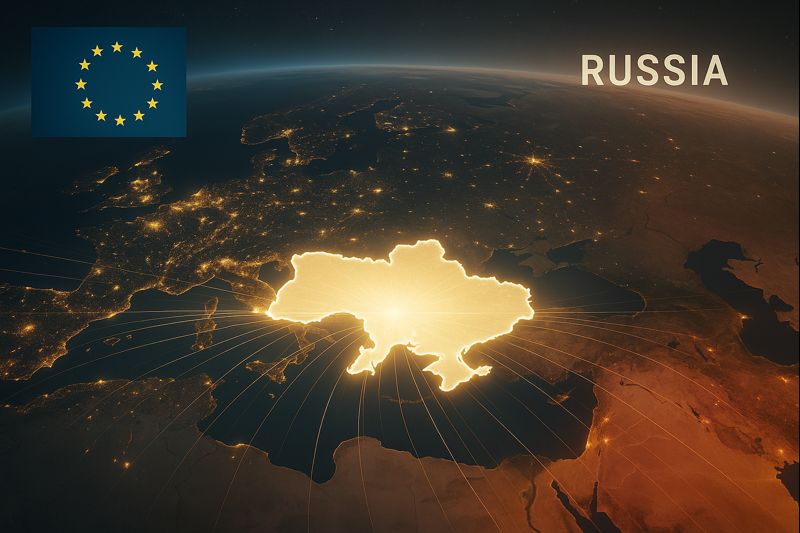
A Neutral, EU-Integrated, Eurasian-Connected Ukraine with a Realistic Donbas Settlement
The war in Ukraine continues because each actor—Ukraine, Russia, Europe, and the United States—operates within a conceptual frame that cannot converge with the others. Negotiations fail not because diplomats lack creativity, but because the underlying categories themselves are incompatible. As long as the conversation is about NATO expansion, historical claims, military victory, or territorial restitution, no shared path emerges.
A durable peace requires a different architecture—one that changes how Ukraine fits into the larger Eurasian system rather than disputing where a line on a map should run. The Kyiv Bridge Peace Plan proposes exactly such a shift. It builds Ukraine as a constitutionally neutral state, deeply integrated with the European Union and simultaneously connected economically to the Eurasian Economic Union. In this design, Ukraine becomes a bridge country, a corridor linking two incompatible economic blocs, making stability more valuable to all sides than continued conflict.
This architecture includes three essential mechanisms: an immediate ceasefire, a stepwise lifting of sanctions on Russia, and a realistic settlement for the Donbas, which acknowledges current military realities while preventing the region from becoming a permanent wound in the European security landscape.
1. Ending the War: A Ceasefire That Can Actually Work
A peace plan must begin with an immediate cessation of hostilities that does not depend on resolving final political questions. The Freeze & Verify Protocol is designed to halt the fighting within hours.
Once Ukraine, Russia, and an EU representative sign a ceasefire declaration—publicly endorsed by the UN—the guns stop. The frontline is frozen as it exists at that moment, recorded through satellite imaging and neutral drone surveillance. No negotiation is needed; reality defines the line.
Within days, UN–OSCE teams move into position along the frozen front. Heavy artillery is pulled back, observation corridors open, and violations face automatic consequences. Not political responses—automatic ones. If either side tests the ceasefire, sanctions relief reverses instantly and the diplomatic process stops. This is how the war ends before the details of peace are settled.
2. Incentivizing Moscow: A Clear Path to Sanctions Removal
Russia will not engage seriously in political negotiation unless it has something to gain immediately. The plan therefore links sanctions removal directly to verified compliance in a way that is both predictable and mechanically enforced.
Sanctions are divided into three groups.
The first group is lifted within seventy-two hours if the ceasefire holds. These early steps—partial banking access, easing of aviation restrictions, and selected personal sanctions—signal that the West is prepared to de-escalate if Russia stabilizes the situation.
After a month of verified calm, a second group comes off: industrial cooperation resumes, broader banking restoration follows, and certain frozen assets begin flowing into a reconstruction escrow mechanism.
The final group is removed the moment the Tripartite Grand Treaty is signed. That signature, rather than years of implementation, is the threshold for full normalization. But the system remains reversible. Any material breach brings the sanctions back automatically. Incentives and discipline are fused into one structure.
3. The Geoeconomic Logic: Ukraine as a Eurasian Bridge
At the heart of the plan is an economic idea: that Ukraine’s central geographic position gives it the potential to become a trade-creation engine between the EU and the EAEU. Today, high tariffs, misaligned regulations, and obstructed transit corridors tear Eurasian supply chains apart. Ukraine could become the link that allows inputs, energy, raw materials, and advanced industrial goods to flow efficiently across the continent.
For the EU, Ukraine’s mineral wealth—lithium, titanium, graphite, and manganese—represents a strategic resource base for the green and digital transition. For the EAEU, Ukrainian transit routes remain the shortest path to European markets. A stable, neutral Ukraine becomes indispensable to both sides.
This shared dependence is the true security guarantee. Countries do not destroy the infrastructure that sustains their economies. Interdependence becomes the new deterrence.
4. Reconciling Institutions: Layered Integration Instead of Impossible Choices
Ukraine cannot join both the EU customs union and the EAEU customs union; the laws of these systems make that impossible. But Ukraine does not need to join both. It only needs to interface with both.
This is achieved through a layered structure. With the EU, Ukraine follows the established path toward deep integration: adopting the acquis, joining the Single Market, and receiving reconstruction funding. With the EAEU, Ukraine does not seek membership but negotiates a Special Economic Interface Status, allowing for mutual recognition of standards in selected sectors, low-tariff transit arrangements, and shared logistics infrastructure.
WTO rules allow this through a tailored exemption under GATT Article XXIV. The world has never seen a hybrid arrangement exactly like this, but Ukraine’s geography demands institutional innovation, not repetition of older models.
5. Neutrality as Ukraine’s Strategic Identity
A neutral Ukraine is not a concession to Russia; it is the legal and political foundation that makes the bridge model possible. Neutrality is written into the Ukrainian constitution, prohibiting foreign military bases and binding future governments to non-alignment unless the public specifically overturns it through referendum.
This meets Russia’s core security concern while still allowing Ukraine to integrate economically and politically with the European Union. Neutrality becomes the stabilizing middle layer between two incompatible security systems.
6. The Donbas: A Realistic Settlement Within This Framework
The war has produced a harsh reality: Russia controls the Donbas and has no strategic incentive to relinquish it. Ukraine, meanwhile, cannot retake it militarily without risking further territorial losses. A viable peace plan must therefore abandon the idea of reintegrating Donbas by force or insisting on immediate legal reversal.
Yet allowing Donbas to remain a militarized, isolated Russian stronghold would embed permanent instability on Ukraine’s frontier. The only workable solution is to convert Donbas from a battlefield into a functional interface.
The result is a Donbas Cross-Border Interface Zone. Legally, Ukraine does not recognize Russia’s annexation. Practically, it accepts the current line as a working border—not legitimizing it, but acknowledging reality to secure peace elsewhere.
In return for this de facto acceptance, Russia commits to allow Donbas to serve as an economic and humanitarian passageway rather than a closed fortress. Residents have simplified travel access to Ukraine. Cultural institutions operate on both sides. Logistics centers are built on both sides of the line, enabling industry from Russia, Ukraine, and third countries to benefit from reduced barriers. Infrastructure—pipelines, rail lines, electricity networks—remains accessible and protected under treaty obligations.
Russia keeps the territory.
Ukraine prevents it from becoming a poison tooth.
Both gain economically from keeping it open.
This is not a sentimental solution. It is a hard-edged, realpolitik conversion of an irreversible loss into a structural advantage.
7. The Grand Treaty That Holds the System Together
The Tripartite Grand Treaty between Ukraine, the EU, and Russia formalizes:
- Ukraine’s neutrality,
- the sanctions-relief mechanism,
- the Donbas interface zone,
- EU integration commitments,
- EAEU access rules,
- verification missions,
- and crisis-management channels.
This treaty does not reconcile worldviews. It builds a new operating system that makes worldview clashes less destructive.
8. How the Plan Unfolds Over Time
The plan begins with the ceasefire and early sanctions relief. Once calm holds, negotiations proceed. The treaty is drafted and signed. From that moment, the sanctions architecture dissolves, and reconstruction funding begins flowing into Ukraine. Over years, Ukraine integrates with the EU economic system while developing structured access to Eurasian markets. Donbas, though Russian-controlled, becomes a functional corridor rather than a frozen conflict.
As economic ties deepen across the region, the incentives for renewed conflict vanish. Ukraine’s neutrality becomes more than a legal clause; it becomes the condition that makes the entire Eurasian economic bridge possible.
Conclusion
This revised Kyiv Bridge Peace Plan does not seek to resolve history. It seeks to resolve the future by replacing territorial absolutism with geoeconomic logic. It accepts that Donbas will not return to Ukraine under present conditions, while refusing to let this loss define the region’s destiny. By transforming Ukraine into the essential corridor between Europe and Eurasia—and Donbas into a cross-border interface rather than a sealed, militarized block—the plan anchors stability in mutual benefit rather than coercion.
This is not the peace that either side imagined at the beginning of the war. But it is the peace that remains possible—and the only one capable of shaping a stable Eurasian order.


