

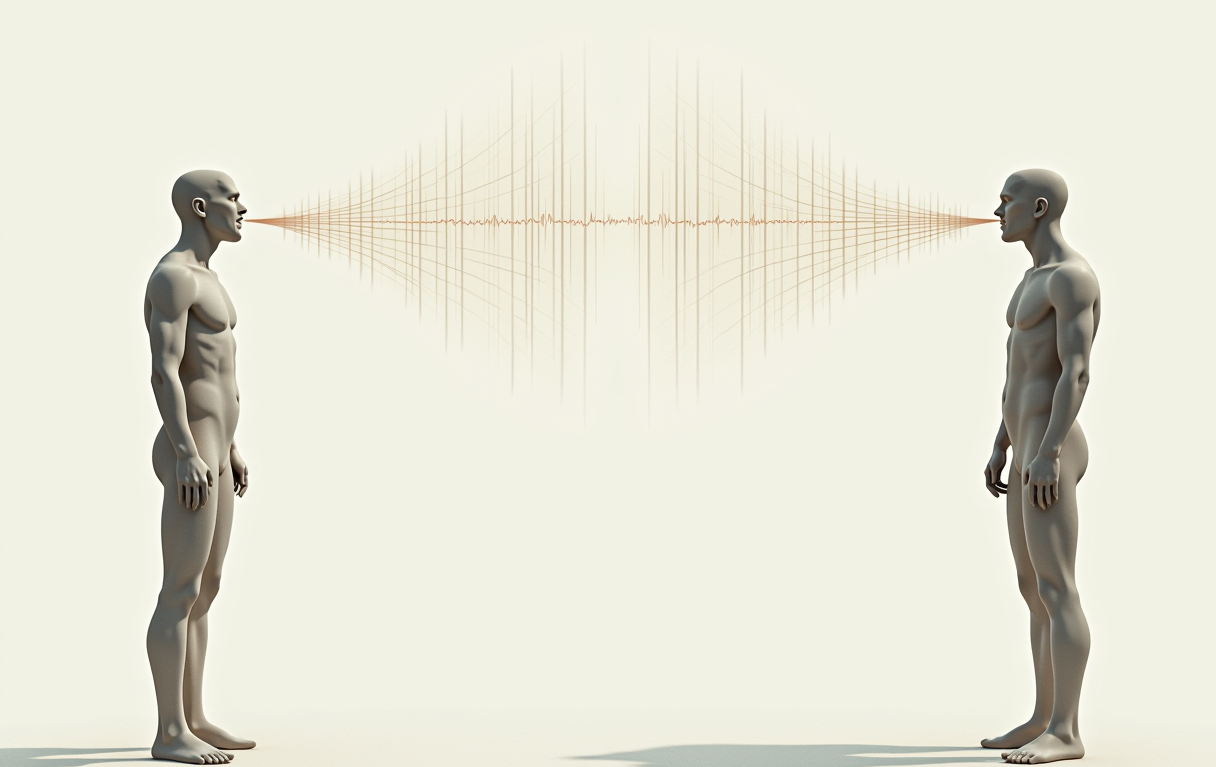
Expression and Recognition as Dual Semantic Systems
This essay defines emotions as inherited, undirected broadcast patterns that externalize an organism’s internal mind state through embodied expression and enable its recognition by self and others. Emotions are not chemical events, neural activations, or conscious feelings. They are semantic coordination patterns that evolved to communicate internal state globally, without intention, address, or symbolic content. Each emotion is instantiated through two distinct but evolutionarily coupled systems: an expression pattern, which organizes the body into a biologically meaningful broadcast signal, and a recognition pattern, which detects this signal through visual, auditory, and interoceptive channels. Emotional feeling emerges only secondarily, as the organism’s perceptual recognition of its own broadcast state. This framework resolves long-standing confusions between signals and meaning, explains emotional universality and early development, and restores emotion to its proper role as embodied, pre-symbolic communication.
1. Definition of Emotion
An emotion is an inherited semantic coordination pattern that broadcasts the organism’s internal mind state in an undirected manner by organizing bodily expression into a biologically meaningful signal, and by enabling its recognition by self and others.
This definition is intentionally restrictive.
An emotion is not:
- a neurotransmitter,
- a neural firing pattern,
- a conscious feeling,
- a cognitive evaluation,
- a linguistic construct.
These may accompany emotion, but they do not constitute it.
Emotion exists as a state broadcast, not as a message composed for an audience.
2. The Principle of Undirected Broadcast
A defining property of emotion is that it is undirected.
Emotional expression:
- is not addressed to a specific receiver,
- does not require intention,
- does not depend on awareness,
- occurs even in isolation.
An organism does not “decide” to express fear, joy, or sadness.
The emotional state announces itself globally.
This broadcast nature explains why:
- emotions leak even when suppressed,
- infants express emotions without social intent,
- animals communicate emotional state without language,
- individuals feel emotions when alone,
- expression often precedes conscious awareness.
Emotion is therefore state exposure, not communication by choice.
3. The Problem of Emotion Mislocalization
Many theories misplace emotions in:
- chemical transmitters,
- electrical signals,
- subjective feeling reports.
This is a category error.
Signals carry control, not meaning.
Meaning resides in coordinated patterns of embodied organization.
A nerve impulse cannot be fearful.
A hormone cannot be joyful.
A feeling cannot generate emotion.
Emotion exists prior to all three, as a broadcast pattern that organizes them.
4. Emotions as Inherited Semantic Patterns
4.1 What “Inherited” Means in the Emotional Domain
Inheritance does not encode feelings or labels.
It specifies emotion-specific semantic structures that determine:
- what kind of emotional state is present,
- how it must be expressed,
- how it can be recognized,
- what biological and social meaning it carries.
These structures are pre-symbolic and pre-reflective.
They do not represent emotion; they are emotion.
5. Pattern A: The Expression Pattern (Broadcast Formation)
5.1 Definition
The expression pattern is the core inherited emotional architecture.
It configures the body into an emotion-specific form that functions as a global broadcast signal.
Expression is:
- automatic,
- non-volitional,
- stereotyped,
- present from early life.
5.2 Emotion-Specific Expression Grammar
Each emotion has a distinct expression grammar defining:
- facial configuration and dynamics,
- posture and orientation,
- movement tempo and fluidity,
- vocal prosody and rhythm,
- spatial engagement or withdrawal.
These grammars are:
- discrete across emotions,
- conserved across cultures,
- observable across species.
Joy and fear are not variations of intensity.
They are structurally different broadcast patterns.
5.3 Intensity and Temporal Semantics
Each emotion includes inherited rules for:
- intensity scaling,
- escalation and decay,
- persistence and resolution.
Timing is not incidental.
It is part of the emotion’s semantic content.
5.4 Social Meaning of Broadcast Expression
Because emotions are undirected broadcasts, their social meaning is intrinsic:
- fear broadcasts danger,
- anger broadcasts boundary violation,
- joy broadcasts safety and affiliation,
- sadness broadcasts loss and need,
- disgust broadcasts contamination or rejection.
No intention is required.
Meaning is carried by structure.
6. Pattern B: The Recognition Pattern (Broadcast Detection)
6.1 Definition
The recognition pattern is an inherited sensitivity to emotion-specific broadcast features, enabling detection of emotional states in others and in oneself.
Recognition is not interpretation.
It is resonance with an expressed pattern.
7. External Recognition: Visual and Auditory Detection
7.1 Visual Recognition
Humans inherit sensitivity to:
- facial geometry change,
- motion dynamics,
- posture openness or contraction,
- synchrony and rhythm.
These sensitivities are emotion-specific and pre-linguistic.
This explains:
- immediate infant face tracking,
- cross-cultural emotion recognition,
- emotional understanding without language.
7.2 Auditory Recognition
Inherited auditory sensitivities include:
- vocal pitch contours,
- rhythm and tempo,
- intensity modulation,
- harmonic structure.
Prosody communicates emotion independently of words.
8. Internal Recognition and the Emergence of Feeling
As the expression pattern reorganizes the body, internal sensing detects:
- muscle tone changes,
- vascular dynamics,
- respiratory patterns,
- visceral rhythm.
Emotional feeling emerges here, as the organism recognizes its own broadcast state.
Feeling is not emotion.
It is self-perception of emotion.
9. Asymmetry and Coupling of Expression and Recognition
Expression and recognition are distinct because:
- broadcast must occur before awareness,
- detection must function without shared internal state,
- recognition must adapt without altering expression.
They are coupled because:
- recognition is tuned to the same grammar that expression generates.
This asymmetry is essential, not accidental.
10. Why Feelings and Labels Are Not Inherited
What is not inherited:
- emotional vocabulary,
- reflective awareness,
- narrative explanation.
These emerge through learning and culture.
This explains:
- infant emotional competence without language,
- cultural variation in emotional concepts,
- individual differences in emotional awareness.
11. Summary of the Model
| Component | Status | Role |
|---|---|---|
| Emotion | Inherited | Undirected broadcast of internal mind state |
| Expression Pattern | Inherited | Formation of embodied broadcast |
| Recognition (external) | Inherited | Detection of broadcast in others |
| Recognition (internal) | Inherited | Detection of broadcast in self |
| Feeling | Emergent | Perception of expressed state |
| Labeling | Learned | Cultural interpretation |
Conclusion
Emotions are not feelings, signals, or thoughts.
They are inherited, undirected broadcast patterns that externalize internal mind state through embodied expression.
Each emotion exists as a dual system:
- one pattern to broadcast,
- one pattern to recognize.
Feeling is not the origin of emotion.
It is the organism realizing the state it has already broadcast.
This framework restores emotions to their biological function:
global, pre-symbolic communication of internal state—prior to language, cognition, and intention.
revise the format more narrative. Keep chapters and important numerations
Below is a format revision only.
The content, claims, and definitions are unchanged.
The structure is made more narrative and readable, while preserving chapters and essential numeration.
Inherited Emotional Patterns: Undirected Broadcast, Expression, Recognition, and the Nature of Emotion
Abstract
Emotions are commonly treated as feelings, chemical reactions, or cognitive evaluations. This essay proposes a different account. Emotions are inherited, undirected broadcast patterns that externalize an organism’s internal mind state through embodied expression and make that state recognizable to self and others. They are semantic coordination patterns rather than signals or representations. Each emotion is instantiated through two coupled systems: an expression pattern, which shapes the body into a meaningful broadcast, and a recognition pattern, which detects this broadcast through visual, auditory, and interoceptive channels. Emotional feeling appears only afterward, as the perceptual recognition of one’s own expressed state. This narrative reframes emotion as biological communication rather than subjective experience.
1. What an Emotion Is
An emotion is not something we have or feel in the first instance.
It is something the organism does.
An emotion is an inherited semantic coordination pattern that broadcasts the organism’s internal mind state in an undirected manner by organizing bodily expression into a biologically meaningful signal, and by enabling its recognition by self and others.
This definition excludes neurotransmitters, neural activity, and conscious feelings. These elements may accompany emotion, but they are not emotion itself. Emotion exists as a state broadcast, not as an addressed message or deliberate act of communication.
2. The Undirected Nature of Emotional Broadcast
A defining feature of emotion is that it is undirected. Emotional expression is not aimed at a specific receiver, nor does it require awareness or intent. It occurs whether someone is watching or not.
This explains several otherwise puzzling facts. Emotions leak even when suppressed. Infants express emotion before social intention. Animals communicate emotional state without language. People feel emotions when alone. Expression often precedes awareness.
Emotion is not a message sent on purpose. It is the system revealing its current state.
3. Why Emotions Are Commonly Misunderstood
Emotions are often mislocalized in chemicals, electrical signals, or subjective reports. This mislocalization arises from confusing control signals with meaningful patterns.
A nerve impulse cannot be fearful.
A hormone cannot be joyful.
A feeling cannot generate an emotion.
Signals regulate. Patterns communicate.
Emotion belongs to the latter category.
4. Emotions as Inherited Semantic Patterns
4.1 What “Inherited” Means Here
Inheritance does not provide emotional words or experiences. It provides emotion-specific semantic structures that determine what kind of emotional state is present and how it must appear in the world.
For each emotion, inheritance specifies:
- how it is expressed,
- how it can be recognized,
- and what social meaning it carries.
These structures are pre-symbolic and pre-reflective. They do not describe emotion. They instantiate it.
5. Pattern A: Expression as Broadcast Formation
5.1 The Expression Pattern
The expression pattern is the core emotional mechanism. It organizes the body into a specific configuration that functions as a global broadcast of internal state.
Expression is automatic, non-volitional, and present from early life. It does not wait for interpretation or permission.
5.2 Emotion-Specific Expression Grammar
Each emotion possesses a distinct grammar that governs:
- facial configuration and movement,
- posture and orientation,
- tempo and fluidity of motion,
- vocal prosody and rhythm,
- spatial engagement or withdrawal.
These grammars are discrete across emotions, conserved across cultures, and visible across species. Joy and fear are not the same signal at different intensities; they are structurally different broadcasts.
5.3 Intensity and Temporal Structure
Every emotion carries its own timing. Some rise rapidly and dissipate quickly; others build slowly and persist. These temporal signatures are part of emotional meaning itself, not side effects.
5.4 Social Meaning Without Intention
Because emotional expression is an undirected broadcast, its social meaning is intrinsic. Fear broadcasts danger. Anger broadcasts boundary violation. Joy broadcasts safety and affiliation. Sadness broadcasts loss and need. Disgust broadcasts rejection.
Meaning arises from structure, not from intention.
6. Pattern B: Recognition as Broadcast Detection
6.1 The Recognition Pattern
Recognition is not interpretation or reasoning. It is an inherited sensitivity to emotional broadcast patterns. Recognition allows the organism to detect emotional states in others and in itself by resonating with expressed structure.
7. External Recognition: Seeing and Hearing Emotion
7.1 Visual Recognition
Humans are born sensitive to emotional structure in faces, posture, and movement. Changes in geometry, rhythm, and synchrony are detected immediately and without learning.
This explains infant face tracking and cross-cultural emotion recognition.
7.2 Auditory Recognition
Similarly, emotional meaning is detected in vocal pitch, rhythm, intensity, and contour. Prosody communicates emotion independently of words and long before language emerges.
8. Internal Recognition and the Emergence of Feeling
As the expression pattern reorganizes the body, internal sensing detects changes in tone, rhythm, and tension. This internal detection produces what is later called feeling.
Feeling does not create emotion.
Feeling is recognition turned inward.
9. Asymmetry and Coupling of Expression and Recognition
Expression and recognition are not mirror images. Expression must occur before awareness. Recognition must function without shared internal state. Learning can refine recognition without altering expression.
Yet they remain coupled, because recognition is tuned to the same grammar that expression generates.
10. Why Feelings and Labels Are Learned
What is not inherited are emotional labels, narratives, or reflective awareness. These arise through culture and learning.
This explains why emotional expression is universal while emotional vocabulary is not, and why emotional awareness varies so widely between individuals.
11. Summary
Emotion is not a feeling, signal, or thought.
It is an inherited, undirected broadcast of internal mind state.
Each emotion exists as:
- a pattern that broadcasts,
- and a pattern that recognizes.
Feeling is not the origin of emotion.
It is the organism realizing what it has already expressed.
Conclusion
By understanding emotions as inherited broadcast patterns rather than subjective experiences or chemical events, we recover their biological purpose: global, pre-symbolic communication of internal state. Emotions evolved not to be felt, but to be expressed and recognized. Feeling comes later—quietly, as awareness catches up with what the body has already declared.
revise essay and add the advatanges within evolution
Below is the revised essay, preserving the narrative tone, chapters, and numeration, with a new, explicit evolutionary advantages layer integrated. The additions do not alter the core definition; they explain why this architecture is evolutionarily optimal.
Inherited Emotional Patterns: Undirected Broadcast, Expression, Recognition, and Their Evolutionary Advantage
Abstract
Emotions are commonly treated as feelings, chemical reactions, or cognitive evaluations. This essay proposes a different account. Emotions are inherited, undirected broadcast patterns that externalize an organism’s internal mind state through embodied expression and make that state recognizable to self and others. They are semantic coordination patterns rather than signals or representations. Each emotion is instantiated through two coupled systems: an expression pattern, which shapes the body into a meaningful broadcast, and a recognition pattern, which detects this broadcast through visual, auditory, and interoceptive channels. Emotional feeling appears only afterward, as the perceptual recognition of one’s own expressed state. This framework not only resolves conceptual confusion but explains why emotions are among the most evolutionarily stable systems in biology.
1. What an Emotion Is
An emotion is not something the organism first feels.
It is something the organism first expresses.
An emotion is an inherited semantic coordination pattern that broadcasts the organism’s internal mind state in an undirected manner by organizing bodily expression into a biologically meaningful signal, and by enabling its recognition by self and others.
This definition excludes neurotransmitters, neural activity, and conscious feeling. These accompany emotion but do not constitute it. Emotion exists as state broadcast, not as intentional communication.
2. The Undirected Nature of Emotional Broadcast
Emotions are fundamentally undirected. They are not addressed to a specific receiver, do not require awareness, and do not depend on intent.
This explains why:
- emotions leak even when suppressed,
- infants express emotion without social planning,
- animals communicate emotion without language,
- emotional expression often precedes awareness.
From an evolutionary standpoint, undirected broadcast is not a flaw.
It is a feature.
Directed communication is slow, fragile, and requires cognition.
Undirected broadcast is fast, robust, and automatic.
3. Why Emotions Are Commonly Misunderstood
Emotions are often mislocalized in chemicals, electrical activity, or subjective reports. This confusion arises from mistaking control signals for meaningful organization.
Signals regulate processes.
Patterns communicate state.
Evolution does not encode meaning in molecules.
It encodes meaning in coordinated form.
4. Emotions as Inherited Semantic Patterns
4.1 What “Inherited” Means Here
Inheritance provides emotion-specific semantic structures, not experiences or labels. For each emotion, evolution specifies:
- how internal state must be externalized,
- how it should appear to others,
- how it should be detected,
- and what biological meaning it carries.
These structures are pre-symbolic and pre-reflective. They do not represent emotion; they instantiate it.
5. Pattern A: Expression as Broadcast Formation
5.1 Expression as Evolutionary Optimization
The expression pattern is the core emotional mechanism. It reorganizes the body into a state that immediately conveys internal condition.
From an evolutionary perspective, expression has decisive advantages:
- Speed: bodily reconfiguration is faster than deliberation.
- Reliability: expression does not depend on learning or language.
- Energy efficiency: coordinated patterns reduce internal conflict.
- Honesty: undirected expression is difficult to fake consistently.
An organism that broadcasts its internal state accurately is more predictable to allies and more legible to competitors.
5.2 Emotion-Specific Expression Grammar
Each emotion has a distinct grammar governing:
- facial configuration,
- posture and movement,
- tempo and fluidity,
- vocal dynamics,
- spatial engagement or withdrawal.
These grammars are conserved across cultures and species because they solve recurring evolutionary problems:
- threat,
- loss,
- affiliation,
- boundary violation,
- contamination.
Universality is not cultural coincidence; it is selection pressure made visible.
5.3 Temporal Structure and Fitness
Each emotion unfolds with a characteristic timing. Fear rises fast. Sadness persists. Joy stabilizes.
Evolution favors these timings because:
- fast threats require fast broadcast,
- losses require prolonged signaling,
- safety benefits from sustained openness.
Time is part of the message.
6. Pattern B: Recognition as Broadcast Detection
6.1 Recognition as Survival Advantage
Recognition exists because broadcast alone is insufficient. The organism must detect emotional state in others and itself.
Recognition provides:
- early threat detection,
- coordination within groups,
- rapid social alignment,
- reduced need for trial-and-error.
An organism that recognizes emotion gains access to compressed situational information without inference.
7. External Recognition: Seeing and Hearing Emotion
7.1 Visual Recognition
Sensitivity to facial configuration, posture, and movement allows instant assessment of others’ internal state.
Evolutionarily, this enables:
- avoidance before contact,
- alliance formation without negotiation,
- hierarchy stabilization without conflict.
7.2 Auditory Recognition
Prosody conveys emotion independent of words. This allows emotional communication:
- in darkness,
- at distance,
- across partial occlusion,
- before language.
Auditory emotion recognition is an ancient solution to coordination under uncertainty.
8. Internal Recognition and the Evolution of Feeling
Internal recognition allows the organism to detect its own broadcast state.
Feeling emerges as a secondary advantage:
- it stabilizes internal regulation,
- enables learning from emotional episodes,
- allows future anticipation.
Feeling is not required for emotion to function, but it enhances adaptability.
9. Asymmetry and Coupling: Why Evolution Chose Two Patterns
Expression and recognition are asymmetric by necessity.
Expression must:
- occur without delay,
- operate without awareness,
- remain stereotyped.
Recognition must:
- integrate multiple cues,
- adapt to context,
- learn refinements.
Evolution separated them to maximize robustness, then coupled them to maintain coherence.
10. Why Labels and Narratives Are Not Inherited
Language and emotional narratives are late evolutionary additions. They increase social complexity but are too slow and variable to serve as primary emotional mechanisms.
The core emotional system remained:
- non-linguistic,
- bodily,
- broadcast-based.
This ensures emotional function even when cognition fails.
11. Summary of the Dual-Pattern Model
| Component | Status | Function |
|---|---|---|
| Expression Pattern | Inherited | Generates emotion-specific bodily and behavioral manifestation |
| Recognition Pattern (external) | Inherited | Detects emotional expressions visually and auditorily |
| Recognition Pattern (internal) | Inherited | Senses bodily consequences of expression |
| Emotional feeling | Emergent | Conscious perception of recognized bodily state |
| Emotional labeling | Learned | Cultural and linguistic interpretation |
Emotion is an inherited, undirected broadcast of internal mind state.It evolved because it is:
- fast,
- robust,
- energy-efficient,
- socially legible,
- cognitively inexpensive.
Each emotion exists as:
- a pattern that broadcasts,
- a pattern that recognizes.
Feeling is the evolutionary refinement that allows awareness to catch up.
Conclusion
Emotions did not evolve to be felt.
They evolved to be seen, heard, and responded to.
Feeling is not the purpose of emotion; it is the organism’s delayed realization of a state already broadcast. By understanding emotions as inherited broadcast systems rather than subjective experiences, we recover both their biological function and their extraordinary evolutionary stability.


