Why do we become the particular persons we are, rather than any of the countless alternatives we might have been? This question precedes morality, psychology, and law. It is asked whenever we judge, diagnose, forgive, or punish. Yet most answers assume that identity is chosen, inherited as character, or consciously learned. This essay argues otherwise. Human identity emerges before intention, self-reflection, or moral reasoning exist. During early development, the brain passively accumulates associations and stabilizes them through Prediction Feedback (PF), a pre-conscious signal of predictive coherence. The resulting noetic horizon silently defines what feels natural, possible, and “like oneself.” Within this framework, crime and so-called perversions are not moral failures or genetic defects but intelligible outcomes of how identity stabilizes under unbalanced PF conditions. We are not the authors of who we are; we are the outcome of what once made our inner world coherent.
We don’t crave recognition out of vanity—we crave it because our brains evolved to learn through it. The recognition loop is a universal, inherited mechanism that once helped us adapt and survive within tribes. But in today’s world of fragmented attention and performative culture, this mechanism traps us in endless cycles of expectation, performance, and emotional dependency. Understanding this loop is the first step toward reclaiming a form of self that no longer waits for applause.
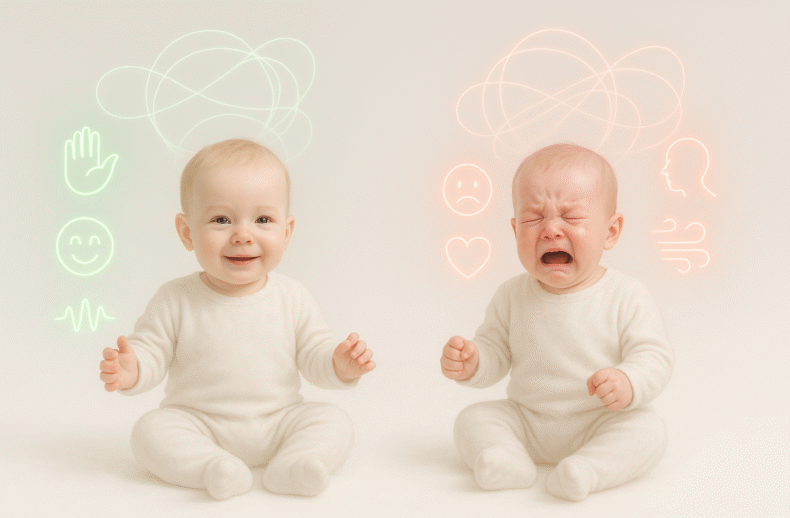
A surreal, soft-white endless space.
Two identical babies—like mirrored copies—sit side by side. Both wear simple, soft white jumpers that blend slightly into the ambient space, emphasizing their purity and unformed identity.
The left baby smiles gently, arms lifted slightly. Around it, glowing green symbols hover: a warm hand, a smiling face, a heart, a gentle soundwave—all symbols of comfort and approval.
The right baby cries with a tense face and clenched fists. Around it, red symbols glow: a turned back, a frowning face, a gust of cold wind, a sharp soundwave—signs of discomfort or rejection.
Behind each baby’s head, translucent neural loops are forming—feedback circuits. The loops behind the left baby are smooth and self-reinforcing. Behind the right, the loops stutter and distort