

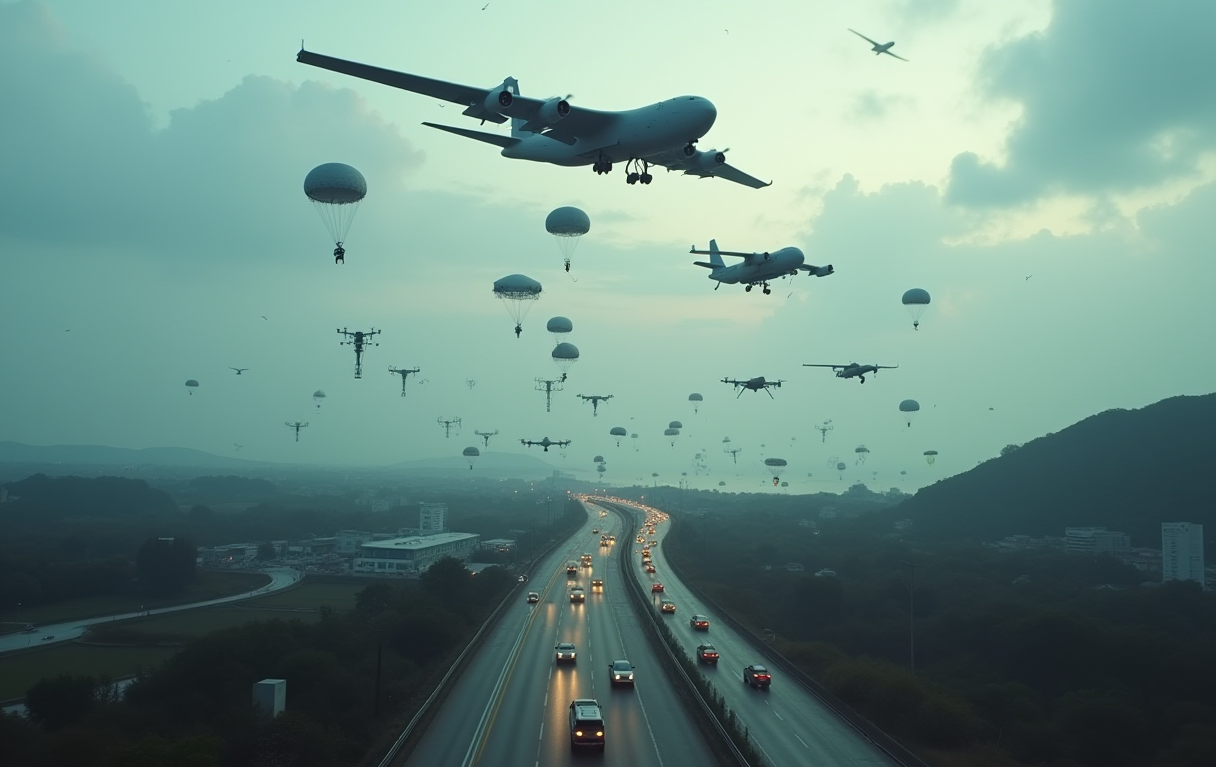
1. Why Robots Will Enter History as Weapons, Not Workers
Public discourse around robotics is dominated by benign images: warehouse automation, elder care, delivery vehicles, household assistants. These narratives suggest a gradual, peaceful diffusion of robots into everyday life, driven by labor shortages and efficiency gains.
History suggests otherwise.
Every transformative technology—metallurgy, combustion engines, aviation, nuclear physics, computing—was first scaled, stress-tested, and normalized in warfare before civilian life absorbed it. Robotics and autonomous systems are following the same path. The economic and social frictions that slow civilian adoption do not exist on the battlefield. War tolerates failure, rewards speed, and prioritizes effectiveness over ethics, cost-efficiency over elegance.
The China–Taiwan conflict is one of the most likely theaters where this historical pattern will repeat. Not because robots are best suited for domestic life—but because warfare is the environment where their advantages are immediately decisive.
2. Why Warfare, Not Civil Society, Is the Natural Entry Point for Robots
2.1. Civilian Robotics Faces Structural Resistance
In civilian contexts, robots encounter persistent barriers:
- high safety requirements,
- liability concerns,
- social resistance,
- regulatory delay,
- and limited tolerance for error.
A malfunctioning household robot is unacceptable. A malfunctioning battlefield robot is expected.
This asymmetry matters. Civilian society demands reliability before scale. Warfare accepts scale before reliability. As a result, the battlefield becomes the natural laboratory for immature but powerful technologies.
2.2. Warfare Rewards Exactly What Robots Offer
Robots excel where humans are weakest:
- sustained presence under threat,
- tolerance for loss,
- operation without rest,
- deployment in overwhelming numbers,
- execution without fear or hesitation.
These are not marginal improvements. They change the structure of conflict itself. A robot does not need to be good. It only needs to be cheap, numerous, and persistent.
No civilian use case values these traits as highly as warfare does.
3. Taiwan as the Ideal Testbed for Robotic Warfare
3.1. Geography That Rewards Saturation Over Brilliance
Taiwan’s western plains, dense cities, limited depth, and critical infrastructure corridors create a battlefield where force density matters more than maneuver. Control of intersections, bridges, ports, airfields, and power nodes is decisive.
Robots do not need to capture territory in the political sense. They only need to deny movement, exhaust defenders, and overload decision-making. This favors systems that can be deployed everywhere at once, even if most are destroyed.
Human forces cannot sustain such density without catastrophic cost. Robots can.
3.2. Industrial Asymmetry Becomes the Decisive Weapon
In a robotic war, victory is no longer tied to elite units or heroic performance. It depends on:
- manufacturing throughput,
- supply-chain resilience,
- software iteration speed,
- and tolerance for material loss.
China’s strength lies precisely here. It can lose thousands of machines per day and replace them without political destabilization. In such a framework, attrition ceases to be a deterrent.
4. Robot Warfare and the Collapse of Psychological Constraints
4.1. Human Warfare Is Psychologically Regulated
Traditional war is constrained by an internal limit: the human cost. Soldiers die, families suffer, societies react. This feedback loop restrains escalation even in authoritarian systems.
This is not ethics; it is biology.
4.2. Robots Break the Feedback Loop
Robotic warfare disrupts this mechanism. The loss of machines produces no grief, no trauma, no demographic scar. Political cost collapses into industrial accounting.
At the same time, visible robotic dominance generates psychological pressure on the opponent: inevitability, exhaustion, and perceived futility. In PF terms, the negative feedback disappears while the positive dominance signal intensifies.
This asymmetry makes robotic warfare uniquely destabilizing. It removes the natural brakes that historically limited conflict intensity.
5. BRICS Stability and the Normalization of Robotic War
5.1. Reduced Fear of Economic Retaliation
A stable BRICS environment insulates China from the most extreme consequences of Western sanctions. Energy flows, raw materials, alternative markets, and political neutrality reduce existential risk.
This does not eliminate cost—but it changes perception. When survival appears manageable, risk tolerance increases.
5.2. Russia’s Role: War as a Learning System
Russia contributes not scale, but knowledge:
- airborne delivery doctrine,
- electronic warfare under combat conditions,
- drone–swarm behavior refined in real conflict,
- acceptance of high-loss experimentation.
China integrates this knowledge with industrial mass production and autonomous navigation. The result is a system optimized not for peace, but for rapid battlefield learning and iteration.
This is precisely how new forms of warfare emerge.
6. Probability Reframed: Robots as the Most Likely First Large-Scale Use Case
6.1. War Is the Fastest Path to Scale
Civilian robotics adoption will be slow, fragmented, and regulated. Military adoption is fast, centralized, and insulated from public resistance.
As a result, the most likely scenario is not “robots gradually entering society,” but robots appearing suddenly, at scale, in war.
6.2. China–Taiwan as the Probable Inflection Point
Under current trajectories and assuming BRICS stability:
- the probability of a major China–Taiwan kinetic conflict by 2040 remains around 50%,
- the probability that such a conflict is robot-centric exceeds 80%,
- yielding an overall ~40% structural likelihood that Taiwan becomes the first large-scale robotic battlefield.
Extreme saturation scenarios are less likely, but still plausible enough—15–20%—to be taken seriously.
7. Strategic Consequences: A New Normal of Conflict
Once robots become the primary instruments of force, warfare shifts from tragedy to process. Escalation becomes easier, pauses shorter, and outcomes more dependent on factories than diplomacy.
Deterrence weakens because punishment no longer hurts in the same way. Peace becomes less stable not because leaders are irrational, but because the cost structure of war has changed.
Taiwan is not unique in this regard—but it is early.
8. Conclusion
Robots will not enter history first as caregivers, companions, or helpers. They will enter history as weapons.
The China–Taiwan conflict sits at the convergence of industrial capability, geopolitical insulation, and technological readiness. In such a setting, robotic warfare is not an exotic choice—it is the most rational one.
If this transition occurs, it will mark a fundamental break in how wars begin, unfold, and end. The decisive factor will no longer be human endurance, but the willingness of states to let machines absorb the violence on their behalf.
The question is no longer whether robots will fight wars.
The question is where—and Taiwan is one of the most likely answers.


