

Inherited Comparators, Predictive Feedback, and Emotions as State Broadcasts
1. Introduction: reframing good and bad as developmental outcomes
Human personality is often described in moral terms: individuals are labeled good or bad, responsible or destructive. These labels implicitly assume conscious choice, ethical reasoning, or deliberate intent. From a biological perspective, this assumption is incorrect at the point where personality direction is first established.
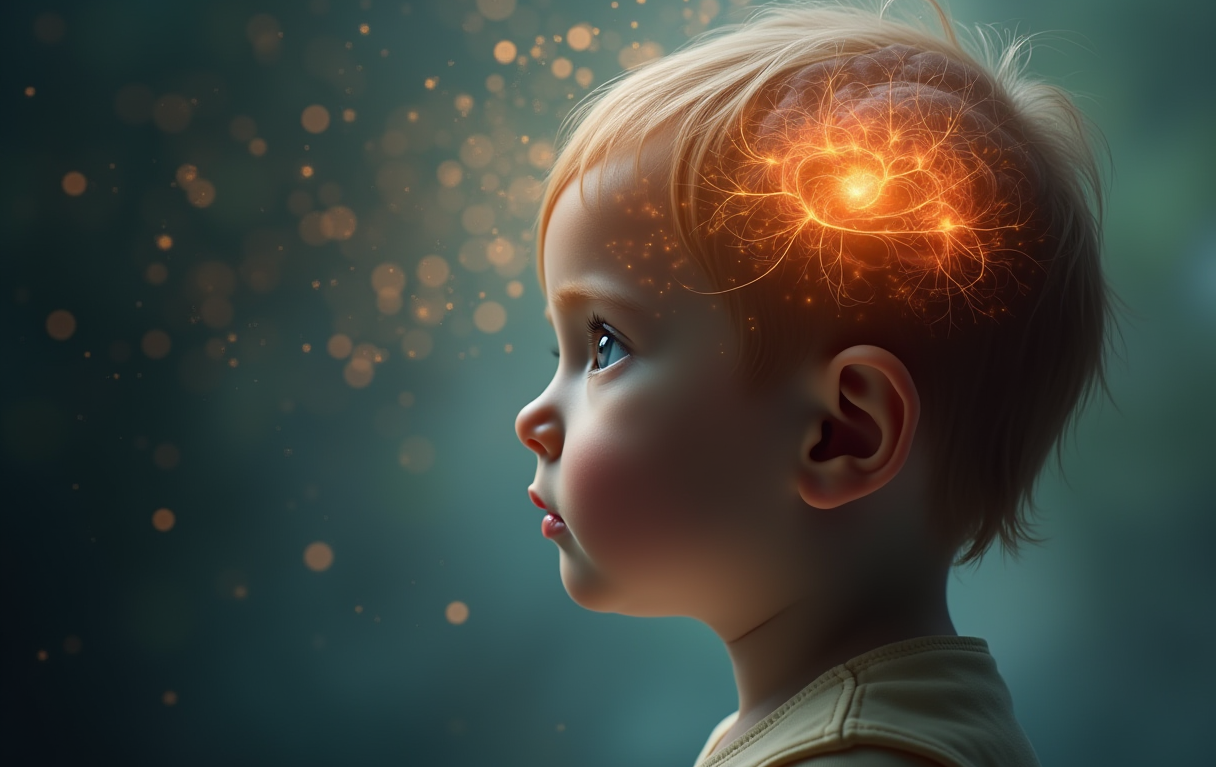
This essay argues that what later appears as “good” or “bad” personality traits emerges from early brain development guided by inherited neural comparators, regulated by Predictive Feedback (PF), and communicated internally and externally through emotions. Personality direction is formed before abstract thinking exists and long before moral reasoning becomes possible.
2. Evaluation before thinking: inherited neural comparators
The infant brain does not think, reason, or compute. However, it evaluates continuously.
This evaluation is enabled by inherited neural comparators—evolutionarily conserved mechanisms that distinguish between internal states such as:
- comfort vs. discomfort
- safety vs. threat
- coherence vs. incoherence
- tolerable vs. intolerable arousal
These comparators do not encode rules or values. They function as biological reference axes, biasing neural activation toward states that maintain viability and away from those that threaten stability.
Evaluation, therefore, is not a cognitive act. It is a regulatory condition of neural dynamics.
3. Predictive Feedback (PF): regulating balance, not reward
Predictive Feedback is the regulatory outcome of comparator activity applied to ongoing prediction chains. PF reflects whether the brain’s internal predictions keep the organism within acceptable comparator-defined bounds.
PF is:
- continuous rather than episodic,
- pre-symbolic rather than conceptual,
- regulatory rather than instructional.
The system does not aim to maximize pleasure or minimize discomfort absolutely. Instead, it seeks balanced regulation—a dynamic equilibrium that permits exploration without collapse and stability without stagnation.
4. Emotions as broadcasted representations of internal state
4.1 What emotions are—and what they are not
Emotions are commonly misunderstood as motivations, decisions, or causes of action. Within this framework, emotions are none of these.
Emotions are the broadcasted representation of the brain’s internal regulatory state.
They are:
- non-directed,
- non-symbolic,
- system-wide signals,
- generated from comparator and PF dynamics.
An emotion does not decide what to do. It informs all subsystems—internal and social—about the current PF balance state.
For example:
- anxiety reflects elevated instability and prediction uncertainty,
- calm reflects regulated coherence,
- anger reflects rapid corrective mobilization under perceived threat.
5. The functional role of emotional broadcasting
Emotional broadcasting serves two essential functions:
- Internal coordination
Emotions synchronize multiple neural systems (attention, memory access, motor readiness) around the same regulatory condition. - External communication
Emotional expression communicates internal state to others, allowing social environments to co-regulate PF balance—long before language exists.
In infancy, emotions are the primary interface between internal regulation and the external world.
6. Early neural imprinting: calibration through emotional feedback
During early childhood, emotional broadcasts repeatedly co-occur with specific contexts, actions, and social responses. These repeated couplings calibrate:
- comparator thresholds,
- PF sensitivity,
- acceptable instability ranges,
- preferred corrective behaviors.
Caregiver responses to emotional signals (soothing, ignoring, punishing, reinforcing) become part of the predictive environment. Over time, the brain stabilizes prediction chains that reliably restore PF balance.
This process—early neural imprinting—occurs before language and conscious reflection, yet it decisively shapes behavioral direction.
7. Development of the prefrontal cortex (PFC)
The prefrontal cortex does not create values or morals. It emerges as a regulatory layer built on earlier stabilized prediction patterns.
As the PFC matures, it enables:
- longer prediction horizons,
- suppression of destabilizing impulses,
- recombination of existing associations.
However, the PFC can only regulate what already exists. Its structure reflects early comparator calibration and emotional-regulatory history.
8. Good and bad as social interpretations of regulation outcomes
Within this framework, “good” and “bad” are not internal brain states. They are social interpretations of behavioral outcomes.
- Behaviors are labeled “good” when they produce predictability, cooperation, and shared stability.
- Behaviors are labeled “bad” when they increase instability or disrupt collective regulation.
From the brain’s perspective, both are attempts to restore PF balance using the strategies learned early.
9. Why reasoning rarely overrides emotion
Because emotions broadcast the current regulatory state, they dominate behavior selection long before reasoning occurs.
Moral reasoning:
- narrates behavior after the fact,
- justifies emotionally stabilized actions,
- provides symbolic coherence.
It does not reconfigure the underlying PF calibration. This explains why:
- moral arguments often fail to change behavior,
- emotional reactions precede ethical justification,
- personality traits remain stable across contexts.
10. Continuity across animals
In other mammals and primates, emotions similarly function as broadcast signals of internal regulation. Early caregiving shapes emotional thresholds, stress responsiveness, and social engagement patterns.
Animals do not reason morally, yet they develop consistent behavioral tendencies. Human personality development is an elaboration—not a replacement—of this conserved biological architecture.
11. Limits of the model
This account does not imply determinism. PF calibration can change under sustained environmental conditions, though slowly. It does not deny social responsibility; it clarifies that responsibility operates on behavioral outcomes, not on the origin of internal states.
12. Conclusion
The developmental origin of good and bad in human personality lies in early brain calibration, not moral choice.
Inherited neural comparators evaluate internal states, Predictive Feedback regulates balance, and emotions broadcast the system’s condition internally and socially. Together, these mechanisms shape the predictive landscape upon which the prefrontal cortex later operates.
What society later names “good” or “bad” personality is the visible outcome of how a brain learned—emotion by emotion—to restore stability in its earliest world.


