Why do we become the particular persons we are, rather than any of the countless alternatives we might have been? This question precedes morality, psychology, and law. It is asked whenever we judge, diagnose, forgive, or punish. Yet most answers assume that identity is chosen, inherited as character, or consciously learned. This essay argues otherwise. Human identity emerges before intention, self-reflection, or moral reasoning exist. During early development, the brain passively accumulates associations and stabilizes them through Prediction Feedback (PF), a pre-conscious signal of predictive coherence. The resulting noetic horizon silently defines what feels natural, possible, and “like oneself.” Within this framework, crime and so-called perversions are not moral failures or genetic defects but intelligible outcomes of how identity stabilizes under unbalanced PF conditions. We are not the authors of who we are; we are the outcome of what once made our inner world coherent.
We don’t crave recognition out of vanity—we crave it because our brains evolved to learn through it. The recognition loop is a universal, inherited mechanism that once helped us adapt and survive within tribes. But in today’s world of fragmented attention and performative culture, this mechanism traps us in endless cycles of expectation, performance, and emotional dependency. Understanding this loop is the first step toward reclaiming a form of self that no longer waits for applause.
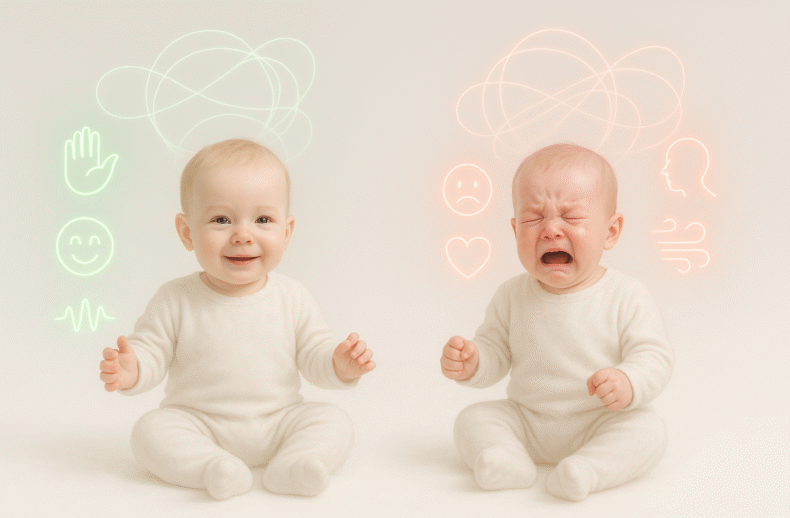
Ein surrealer, weich-weißer, endloser Raum.
Zwei identische Babys sitzen - wie gespiegelte Kopien - nebeneinander. Beide tragen einfache, weiche weiße Pullover, die sich leicht in den Raum einfügen und ihre Reinheit und ungeformte Identität betonen.
Das linke Baby lächelt sanft, die Arme leicht angehoben. Um es herum schweben leuchtend grüne Symbole: eine warme Hand, ein lächelndes Gesicht, ein Herz, eine sanfte Schallwelle - alles Symbole für Trost und Zustimmung.
Das rechte Baby weint mit angespanntem Gesicht und geballten Fäusten. Um es herum leuchten rote Symbole: ein umgedrehter Rücken, ein stirnrunzelndes Gesicht, ein kalter Windstoß, eine scharfe Schallwelle - Zeichen für Unbehagen oder Ablehnung.
Hinter dem Kopf jedes Babys bilden sich durchscheinende neuronale Schleifen - Rückkopplungskreise. Die Schleifen hinter dem linken Baby sind glatt und selbstverstärkend. Hinter dem rechten stottern die Schleifen und verzerren