

How an Iranian Nuclear Demonstration Would Transform Global Strategy
Introduction
The strategic question surrounding Iran is no longer whether military strikes can destroy nuclear facilities. The more fundamental question is whether military pressure changes Iran’s incentives. Every conflict reshapes the beliefs of the participants. If a government concludes that diplomacy cannot guarantee its survival while nuclear deterrence can, then every military operation intended to stop a nuclear program may instead strengthen the political necessity of completing it.
The current crisis is unlike any previous confrontation over Iran’s nuclear program because it unfolds under conditions of profound uncertainty. International inspectors no longer possess continuous knowledge of Iranian nuclear activities, and governments therefore operate without reliable information about the true status of the program. Publicly, no state can demonstrate that Iran is actively building a nuclear weapon. Equally, no state can confidently demonstrate that it is not. This verification blackout fundamentally changes strategic decision making because uncertainty itself becomes a strategic asset.
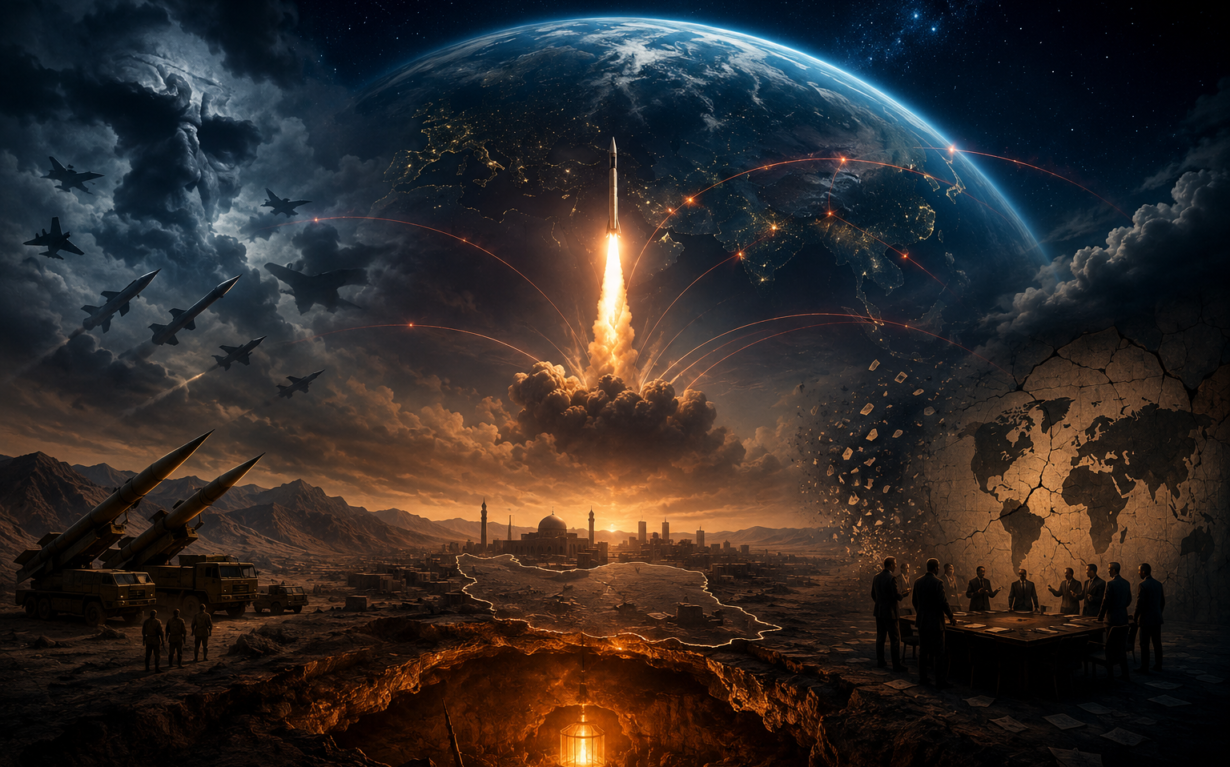
Against this background, consider a hypothetical but plausible scenario. Iran conducts a successful underground nuclear test and, only hours later, launches a large ballistic rocket into orbit. Neither action directly attacks another country, yet together they would alter the strategic balance of the Middle East and perhaps the international system itself. The significance of such a demonstration would not lie primarily in the technology but in the political message it communicates.
Chapter 1 — The Logic of Survival
Western policy has long assumed that economic sanctions, diplomatic negotiations and occasional military strikes would eventually persuade Iran that the costs of acquiring nuclear weapons outweigh the benefits. This assumption reflects a broader belief that states ultimately prioritize economic development and international integration over military confrontation. Such a model may no longer describe how Iranian decision makers perceive their strategic environment.
From Tehran’s perspective, years of sanctions have not ended external pressure. Instead, military strikes, assassinations, cyber operations and attacks against strategic infrastructure may reinforce a different conclusion. Iranian leaders may increasingly believe that conventional military capability, regional alliances and diplomatic engagement cannot reliably prevent future attacks against the state itself. If that perception becomes dominant, the strategic objective changes fundamentally. Nuclear weapons are no longer viewed as instruments of prestige or regional influence but as the final guarantee of regime survival.
History provides powerful examples supporting such a perception. Governments that lacked nuclear deterrence were ultimately vulnerable to overwhelming foreign military intervention, whereas states possessing nuclear weapons have generally become far more difficult to coerce directly. Whether this interpretation represents objective reality is almost secondary. Political leaders act upon their understanding of reality rather than reality itself. Once survival becomes linked to nuclear deterrence, every additional military strike may strengthen rather than weaken the motivation to complete the program.
Chapter 2 — The Verification Blackout
The most dangerous feature of the current crisis is not enrichment itself but the absence of reliable information. Verification has always been the foundation of arms control because transparency reduces uncertainty and uncertainty reduces the likelihood of catastrophic miscalculation. When inspectors lose continuous access, political decisions must increasingly rely on intelligence estimates rather than direct observation. Every estimate contains uncertainty, and uncertainty inevitably encourages worst-case assumptions.
This situation creates a profound strategic asymmetry. Iran knows substantially more about its own capabilities than any external actor. The United States, Israel and European governments must instead make decisions based upon incomplete information. They cannot know precisely how much enriched uranium exists, whether weaponization research has advanced, where critical components may be stored, or how quickly a weapon could potentially be assembled. In such an environment, uncertainty itself becomes a form of deterrence because opponents must prepare for possibilities rather than verified realities.
Chapter 3 — The Game-Theoretical Dilemma of Military Prevention
At first glance, the strategic objectives of the United States and Israel appear straightforward. Military strikes are intended to delay Iran’s nuclear program, destroy critical infrastructure, eliminate key personnel, and increase the economic and technical costs of weaponization. If successful, these actions postpone the moment at which Iran could produce a deployable nuclear weapon.
Game theory, however, suggests that the problem is considerably more complex because both sides continuously adapt their strategies in response to each other’s actions. Neither player makes decisions in isolation. Every move changes the incentives of the opponent, who then chooses the strategy that maximizes its own expected survival. The conflict therefore resembles a dynamic strategic game rather than a simple sequence of military operations.
Consider the incentives facing Tehran before extensive military attacks. Iranian leadership possesses several strategic options. It may continue negotiations, maintain nuclear ambiguity, pursue only civilian enrichment, secretly advance toward weaponization, or openly withdraw from international agreements. Each option carries different political costs and different security benefits. As long as diplomacy remains a credible path toward reducing external pressure, delaying or limiting weaponization remains a rational strategic choice.
Military attacks fundamentally change this payoff structure.
Once the state experiences repeated attacks against its military leadership, intelligence services, industrial infrastructure and strategic facilities, the expected value of remaining a non-nuclear power begins to decline. From the perspective of Iranian decision makers, every successful strike demonstrates not only military superiority but also political vulnerability. The central strategic question gradually changes from “What are the costs of building a bomb?” to “What are the costs of not having one?”
This transformation is the essence of the dilemma.
The United States attacks because it seeks to prevent nuclear deterrence from emerging.
Iran, observing those attacks, may conclude that the attacks themselves prove why nuclear deterrence has become necessary.
In game theory this represents a classic incentive reversal. A strategy designed to reduce the probability of an outcome may simultaneously increase the opponent’s incentive to produce exactly that outcome. Neither side behaves irrationally. Both are responding logically to the incentives created by the other.
The strategic interaction resembles a commitment problem. The United States cannot credibly promise that military pressure will permanently disappear if Iran abandons weaponization, because future American administrations may adopt different policies. Likewise, Iran cannot credibly convince its adversaries that it will never construct nuclear weapons while simultaneously maintaining advanced enrichment capabilities. Since neither side can fully trust the future commitments of the other, both prepare for the worst possible scenario.
The result is a security dilemma in which defensive actions appear offensive to the opposing side. American military strikes are presented domestically as preventive measures intended to reduce future danger. Inside Iran, the very same actions may be interpreted as evidence that conventional military capabilities are insufficient for national survival. Each side therefore interprets its own strategy as defensive while perceiving the opponent’s strategy as aggressive.
This creates a self-reinforcing feedback loop. Every strike delays technical progress but simultaneously strengthens the political argument inside Iran that only a completed nuclear deterrent can prevent future attacks. Every acceleration of the nuclear program then reinforces the Western belief that stronger military pressure is necessary. Both players therefore become trapped in a strategic cycle in which individually rational decisions produce collectively irrational outcomes.
The tragedy is that both sides may be acting consistently with their own security interests while simultaneously making the overall situation more dangerous. In game-theoretical terms, this resembles the dynamics of a Prisoner’s Dilemma. Mutual restraint would produce the safest long-term outcome, yet neither player can confidently rely on the restraint of the other. Consequently, both choose strategies that increase their own immediate security while reducing the security of everyone involved.
If this analysis is correct, the greatest danger does not arise because either side seeks war. It arises because each side, acting rationally within its own strategic framework, unintentionally strengthens the incentives driving the other toward greater escalation. Under these conditions, military prevention and nuclear proliferation cease to be opposing processes. They become mutually reinforcing components of the same strategic game.
Chapter 4 — The Nuclear Demonstration
An underground nuclear test would immediately end decades of strategic ambiguity. For years, international politics has revolved around the question of whether Iran intends to build nuclear weapons. A successful underground detonation would replace speculation with demonstration. The scientific achievement would certainly be significant, but the political consequences would be even greater.
The explosion itself would not create the deterrent. The deterrent would emerge from the countless questions that immediately follow. Intelligence agencies would ask how many devices exist, whether additional weapons have already been produced, where they are located, and whether production can continue despite future military attacks. None of these questions could be answered with certainty. Every uncertainty increases the perceived risks of future military action, and it is precisely this uncertainty that gives nuclear deterrence its extraordinary political power.
Chapter 5 — The Orbital Launch
If Iran followed the underground test with the successful launch of a large rocket into orbit, the strategic message would become considerably stronger. Officially, Tehran would almost certainly describe the mission as peaceful space exploration or scientific progress. Few governments, however, would interpret the launch exclusively through a civilian perspective.
Space launch vehicles and long-range ballistic missiles are not identical technologies, but they share important engineering principles involving propulsion, staging, guidance and payload delivery. Consequently, the political interpretation would dominate the technical one. The launch would communicate that Iran is not merely demonstrating nuclear physics but also signaling continued progress in long-range delivery capability. Whether or not the rocket was ever intended to carry a military payload would become almost irrelevant. The perception of future capability would outweigh the technical details of the specific launch.
Together, the underground test and orbital mission would create a carefully constructed strategic narrative. The first demonstrates the existence of nuclear capability. The second suggests that delivery technology continues to mature. Neither demonstration explicitly threatens another nation, yet together they fundamentally alter how every government evaluates Iranian power.
Chapter 6 — The Psychological Transformation
The immediate consequences would not primarily be military but psychological. Until that moment, governments continue asking whether Iran can still be prevented from becoming a nuclear power. After the demonstration, the central question changes completely. Decision makers begin asking how many devices already exist, whether additional facilities remain undiscovered, and whether future military operations might inadvertently trigger a much larger conflict.
This transition from prevention to uncertainty represents the true beginning of nuclear deterrence. Nuclear weapons derive much of their political influence not from their physical destructive capacity but from the inability of opponents to calculate risks with confidence. Military planning becomes substantially more conservative because every scenario must now incorporate the possibility of undisclosed nuclear capability.
Chapter 7 — From Prevention to Containment
For more than two decades, international strategy has been dominated by prevention. Diplomatic negotiations, sanctions, sabotage, cyber operations and military strikes have all pursued essentially the same objective: preventing Iran from crossing the nuclear threshold. A successful demonstration would end that era almost immediately.
Future strategy would instead focus upon containment. Intelligence collection would intensify, missile defense systems would expand, cyber operations would continue, naval deployments would increase, and regional alliances would strengthen. None of these measures would seek to erase Iranian scientific knowledge because such knowledge cannot be destroyed by military force. Instead, the objective would become limiting the strategic consequences of an already accomplished reality.
Chapter 8 — The Regional Domino Effect
The greatest long-term consequences may not occur inside Iran itself but throughout the Middle East. Every regional government would be forced to reconsider its own security assumptions. States that previously relied upon foreign military guarantees would begin asking whether those guarantees remain sufficient in a region containing a demonstrated nuclear power.
Such reassessments do not automatically produce nuclear proliferation, but they substantially increase its probability. Strategic decisions are driven not only by current threats but by expectations regarding future uncertainty. If neighboring governments conclude that the regional balance of power has permanently shifted, domestic pressure to develop independent strategic capabilities will inevitably increase. In this sense, the greatest danger of an Iranian demonstration lies not in the first bomb but in the possibility that several others eventually follow across the region.
Chapter 8 — A More Stable but More Dangerous World
One of the great paradoxes of nuclear strategy is that acquiring nuclear weapons may simultaneously reduce and increase different forms of conflict. Large-scale invasion becomes less attractive because uncertainty dramatically raises the potential costs. At the same time, covert operations, cyber warfare, proxy conflicts, intelligence competition and economic coercion become even more intense because direct confrontation has become substantially more dangerous.
The Middle East would therefore not become peaceful. Rather, it would evolve toward a permanently frozen strategic competition resembling aspects of the Cold War. Open warfare becomes less likely precisely because the consequences have become so much greater, while indirect confrontation becomes the preferred instrument of competition.
Conclusion — The Moment Prevention Ends
The decisive consequence of an Iranian nuclear demonstration would not be the underground explosion itself. Its true significance would lie in the immediate transformation of strategic decision making. Until that moment, the central objective of the United States and Israel has been prevention. After a successful demonstration, prevention gives way to deterrence. The strategic question changes from “Can Iran still be stopped?” to “How do we manage a nuclear Iran?”
Whether this transition reduces or increases the probability of war depends on how each side interprets the demonstration.
If Iran’s objective is purely deterrence, the demonstration may achieve exactly what Tehran seeks. By proving that it possesses at least a basic nuclear capability, Iran substantially raises the political and military risks of further direct attacks. Every future military operation would carry an additional uncertainty: does Iran possess only the demonstrated device, or has it already produced others? Can those weapons be delivered, or is further development still required? Intelligence agencies would be unable to answer these questions with confidence, and uncertainty itself becomes an instrument of deterrence.
From this perspective, a successful demonstration could significantly reduce the likelihood of routine military strikes against Iranian territory. States generally become more cautious when confronting an opponent that may possess nuclear weapons because even a small probability of nuclear retaliation changes the cost-benefit calculation. The demonstration would therefore achieve its principal political objective: making future attacks appear substantially more dangerous than before.
Yet deterrence does not eliminate danger. It merely changes its form.
The greatest risk emerges during the transition between a non-nuclear and a nuclear strategic environment. If the United States or Israel conclude that Iran possesses only a small number of devices and has not yet established a secure second-strike capability, they may face what game theorists call a closing window. Every month that passes potentially strengthens Iran’s deterrent. If decision makers believe that future military options will become progressively less effective, they may conclude that the present represents the last opportunity to act.
This creates one of the most dangerous moments in international politics. Iran believes the demonstration should prevent further attacks. Its adversaries may instead interpret the demonstration as evidence that time has run out. Both sides believe they are acting defensively. Both perceive delay as benefiting the other. The resulting incentives drive both toward greater rather than lesser confrontation.
Whether this logic ultimately leads to nuclear war is a separate question.
A deliberate nuclear attack by Iran against the United States or Israel immediately after a demonstration would be strategically irrational because it would almost certainly trigger overwhelming retaliation and threaten the survival of the Iranian state itself. Nuclear deterrence has historically been based on preventing war, not initiating it. Possessing a nuclear capability does not automatically make first use attractive; in many strategic models it makes restraint even more valuable because the deterrent achieves its purpose simply by existing.
The more plausible danger lies elsewhere. The existence of nuclear weapons increases the consequences of miscalculation. A conventional missile strike may be interpreted as preparation for a nuclear strike. An intelligence failure may lead one side to believe that the other is preparing imminent use. Political leaders operating under extreme time pressure may act upon incomplete or incorrect information. In nuclear strategy, accidents, false alarms and misperceptions become almost as dangerous as deliberate aggression.
The paradox is therefore profound. An Iranian nuclear demonstration could simultaneously reduce the probability of routine military attacks while increasing the consequences of any future crisis. Stability improves at the strategic level because direct war becomes less attractive, but instability grows during every confrontation because the potential costs have become immeasurably greater.
The ultimate outcome would not be peace, nor immediate catastrophe. It would be the birth of a new strategic order in which every military decision, every diplomatic crisis and every regional conflict unfolds under the permanent shadow of nuclear deterrence. Once that threshold has been crossed, history suggests that returning to the previous security order becomes extraordinarily difficult. The demonstration would not end the conflict between Iran and its adversaries. It would transform the conflict into one governed by permanent mutual deterrence, continuous strategic uncertainty, and the ever-present risk that one miscalculation could produce consequences beyond the imagination of any political leader.


