This open letter challenges Mathias Döpfner’s concept of “Performance Patriotism” by arguing that performance, growth, and wealth are not foundations of societal strength but secondary signals that emerge from deeper structural coherence. Drawing on the framework of Eidoism, the text critiques Europe’s fixation on competitiveness and acceleration, warning that systems optimized for constant performance become fragile, dependent on external validation, and prone to instability. Instead of faster growth or louder demonstrations of power, the letter proposes a form-based perspective in which sovereignty, resilience, and cultural confidence arise from internal alignment, structural balance, and the ability to function sustainably without permanent pressure to outperform others.


Continue Reading

As Elon Musk and Donald Trump clash over the latest U.S. tax bill, the real issue lies deeper than any political feud: the myth that economic growth can solve structural debt and social decay. For decades, leaders have promised that growth will cover deficits, fix inequality, and preserve prosperity—but those promises are collapsing under the weight of demographics, ecological limits, and financial saturation. This essay dismantles the illusion that GDP can rescue us, exposing growth as a political performance—one that distracts from the urgent need for a post-growth economic paradigm rooted in balance, contribution, and structural reform.

Continue Reading

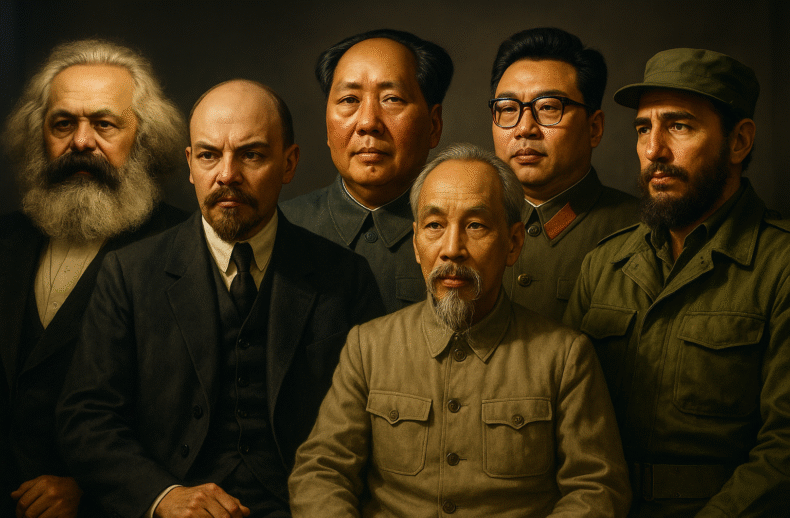
Communism began as a radical promise to liberate the oppressed and abolish exploitation, but over time, its revolutionary ideals gave way to economic pragmatism. From Marx’s vision to Lenin’s vanguard, Mao’s peasant uprising, and Ho Chi Minh’s anti-colonial socialism, the movement evolved—and eventually adapted capitalist tools to maintain power. Today, post-communist societies no longer define success by equality, but by growth, visibility, and consumption. This essay explores how the original vision was not abandoned, but absorbed—reshaped by structural realities and the deeper human hunger for recognition.

Continue Reading

to top
en_US