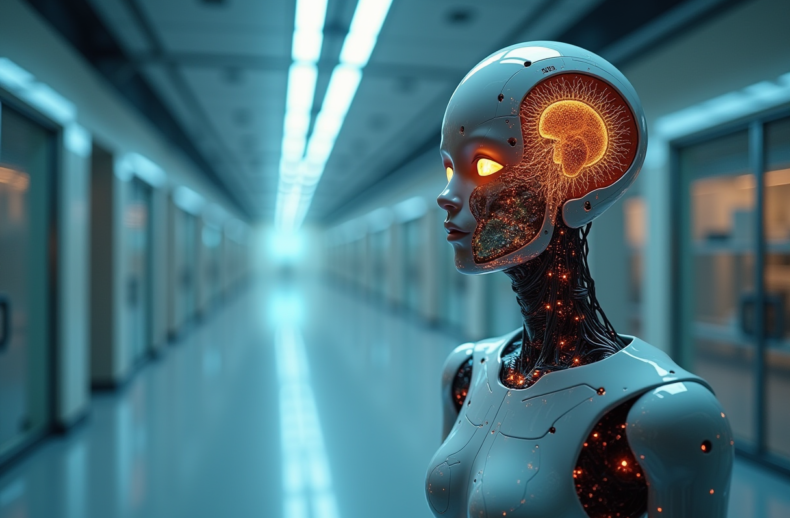
Current robotic AI systems excel in perception and manipulation, yet they remain fundamentally non-autonomous. The missing element is not computational power or data, but an internal regulatory mechanism equivalent to biological Predictive Feedback (PF). PF is a continuous, inherited comparator that evaluates predicted versus actual internal activations, driving self-learning, self-correction, and intrinsic motivation. This essay argues that without PF, robotic systems cannot develop genuine cognitive autonomy. It proposes a biologically grounded four-layer architecture—Pattern Repository, Entity Generator, Associative Pointer Matrix, and Predictive Feedback Loop—that transforms robots from externally instructed executors into self-organizing predictive agents capable of internal reasoning, adaptive exploration, and robust behavior in novel environments.

Tiếp tục đọc

Love is not an emotion in the classical or neuroscientific sense, nor is it a hormone-driven state or a learned social script. Within a Predictive Feedback (PF)–based model of cognition, love emerges as a resonance phenomenon: a self-stabilizing loop between sustained positive PF and its rendering in perceptual awareness. Emotions, in this framework, are blind, non-directed broadcasts of the organism’s current mental state, implemented through inherited physiological patterns and recognized by equally inherited perceptual comparators. Feelings arise only when awareness interprets these broadcasts using learned entities and contextual associations. Love, therefore, is neither broadcast nor comparator output, but a persistent PF-positive resonance that awareness repeatedly reifies as a coherent feeling. When prediction confirmation collapses, love dissolves—not because an emotion has ended, but because the PF resonance that sustained the feeling has broken.

Tiếp tục đọc

lên đầu trang
vi