

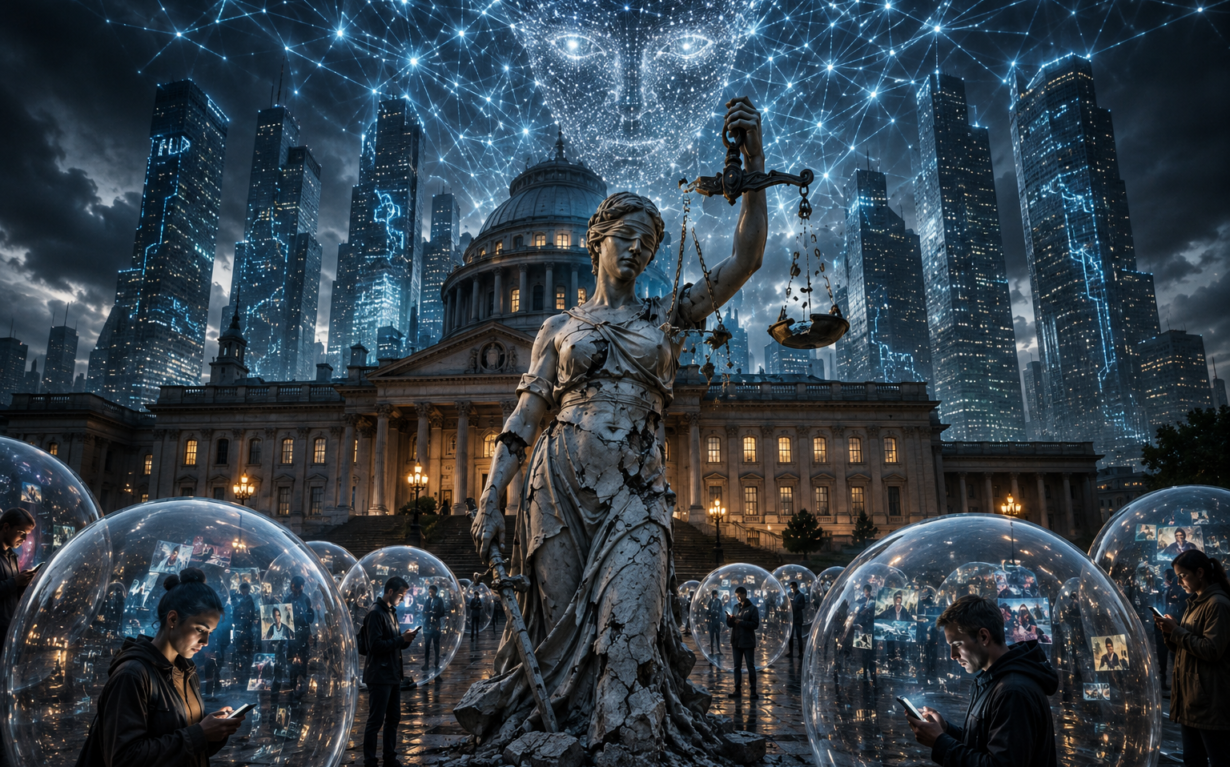
When Prosperity Is No Longer Enough
The twentieth century witnessed the collapse of communism. The twenty-first century will witness the collapse of liberal democracy.
This statement is not intended as political provocation, nor is it a prediction based on today’s election results, opinion polls, or the latest geopolitical crisis. Democracies have survived wars, depressions, revolutions, and terrorism. They are remarkably resilient institutions. Yet resilience should not be confused with permanence. Every political system rests upon assumptions about human nature, and history repeatedly demonstrates that when those assumptions are wrong, the political system eventually collapses regardless of its military strength, economic power, or constitutional sophistication.
The central claim of this essay is simple. Liberal democracy is built upon an incomplete theory of human motivation. It assumes that individual freedom, economic prosperity, and continuous growth are sufficient to maintain political stability. For much of the past century this assumption appeared correct because economic expansion continuously created opportunities for citizens to improve their lives. Prosperity seemed to validate democracy.
It did not.
Economic growth merely concealed democracy’s greatest theoretical weakness. The true foundation of political stability has never been wealth. It has always been recognition.
From the perspective of Eidoism, recognition is the primary social resource. Human beings seek security and material well-being, but beyond survival they seek something even more fundamental. They seek to matter. They seek respect, status, influence, appreciation, belonging, and significance. Every civilization, every religion, every ideology, and every political system distributes recognition in different ways. Those that distribute it successfully remain stable. Those that fail eventually collapse.
Communism ignored recognition by believing equality would eliminate competition. Liberal democracy ignores recognition by believing prosperity can satisfy it indefinitely. Both theories mistake material conditions for the primary driver of human behavior.
The twenty-first century will expose this error.
Chapter 1 – Recognition: The Missing Foundation of Political Theory
Modern political philosophy is remarkably consistent in one respect. Whether discussing capitalism, socialism, liberalism, or Marxism, most political theories explain social order through economics. Wealth, production, ownership, employment, taxation, consumption, and inequality dominate political discourse because they are assumed to determine human behavior. Although these schools of thought disagree profoundly about how an economy should be organized, they share a common premise: improve material conditions and society will become more stable.
Eidoism begins from a very different starting point. Human cognition did not evolve within markets, governments, or financial systems. It evolved over hundreds of thousands of years within small social groups where survival depended as much upon one’s social position as upon access to food or shelter. Individuals who lost the trust, respect, or acceptance of the group often lost protection, cooperation, mating opportunities, and eventually the means to survive. Long before money existed, the human brain had already evolved mechanisms for continuously evaluating social standing, predicting future acceptance, and competing for recognition within the group.
This evolutionary heritage remains visible in modern societies despite the enormous complexity of contemporary civilization. Economic resources certainly matter, but largely because they influence social position. Wealth commands respect, political office commands authority, academic achievement commands prestige, artistic accomplishment commands admiration, and public visibility commands influence. The material object itself is rarely the final objective. More often, it functions as a vehicle through which individuals acquire recognition from others.
Recognition therefore occupies a far more fundamental position than political theory has traditionally acknowledged. Political systems do not create the human desire for recognition, nor can they abolish it. Instead, they determine how recognition is acquired, distributed, and legitimized within society. Once this distinction is understood, many questions that have puzzled economists and political philosophers become considerably easier to answer.
Why does a billionaire continue accumulating wealth long after every material need has been satisfied? Why does a successful politician pursue even greater power despite already possessing privilege and influence? Why do scientists dedicate decades to research that may bring little financial reward, while artists willingly accept poverty in exchange for creative recognition? Why do social movements continue mobilizing long after their original economic demands have been achieved? These behaviors appear irrational if material gain is assumed to be the primary human objective. They become entirely consistent once recognition is understood as the underlying motivation.
From the perspective of Eidoism, economic resources are therefore not the ultimate currency of society. They are one of several instruments through which recognition is obtained. Political theory has largely mistaken the instrument for the objective. As long as recognition remains hidden behind material success, this error is difficult to detect. Once economic growth slows and traditional pathways to social advancement begin to narrow, however, the distinction becomes impossible to ignore. At that point, societies discover that the competition they believed to be economic was, in reality, always a competition for recognition.
Chapter 2 – Communism: History’s First Warning
The collapse of communism should never have surprised political theorists. What ultimately failed was not merely an economic model but a theory of human nature. Marxist thought correctly recognized that economic inequality generates conflict, yet it assumed that inequality was the primary source of competition within society. Once private ownership disappeared and the means of production belonged collectively to the people, class divisions were expected to dissolve, exploitation would end, and cooperation would gradually replace competition. The communist project therefore rested on the belief that changing economic structures would fundamentally change human behavior.
History demonstrated that this assumption was profoundly mistaken. Although communist societies substantially reduced private ownership and attempted to flatten economic hierarchies, they immediately generated new forms of hierarchy. Party membership became a source of prestige and privilege. Bureaucratic positions determined influence. Military rank conveyed authority. Scientists, intellectuals, artists, and writers competed for ideological approval, official appointments, state honours, and political access. Social status remained highly differentiated despite the relative equalization of material resources.
This outcome should not have been interpreted as an accidental failure of implementation. It revealed a much deeper misunderstanding. The object of human competition had never been wealth itself. Wealth had merely been one of the most effective instruments through which recognition could be acquired. Once that instrument became unavailable, competition simply shifted toward other mechanisms capable of producing status, influence, respect, and social significance. The underlying cognitive process remained unchanged because the motivation driving it had never disappeared.
From the perspective of Eidoism, communism attempted to redesign the economic system while leaving untouched the cognitive architecture responsible for social competition. It treated recognition as a secondary consequence of material inequality when, in reality, material inequality was only one expression of a far more fundamental human drive. Recognition cannot be nationalized, legislated into equality, or permanently redistributed because it does not exist as a material resource. It emerges continuously from the way human cognition evaluates relative social position, compares individuals within groups, and predicts future opportunities for influence and acceptance.
The collapse of the Soviet Union therefore represented more than the failure of central planning. It exposed the limits of every political theory that reduces human motivation to material conditions alone. Communism failed because it misunderstood what people ultimately compete for. Liberal democracy reaches the opposite political conclusion, yet it inherits the same psychological error. Instead of believing that equality will eliminate the struggle for recognition, it assumes that continuous economic growth will satisfy it. Both systems assign the decisive role to economics while overlooking the cognitive force that ultimately governs social stability.
Chapter 3 – Democracy’s Prosperity Illusion
Unlike communism, liberal democracy does not seek stability through equality. Its promise is opportunity. The democratic model assumes that free individuals, operating within competitive markets and protected by individual rights, will generate continuous innovation, economic expansion, and rising standards of living. Political legitimacy therefore becomes closely tied to the expectation of progress. As long as citizens believe that tomorrow will offer greater opportunities than today, democratic institutions appear not only effective but also fundamentally just. The promise of a better future becomes the foundation of political stability.
For much of the second half of the twentieth century, history seemed to validate this belief. The decades following the Second World War witnessed an extraordinary period of economic expansion across much of the democratic world. New industries emerged, technological innovation accelerated, universities grew rapidly, international trade expanded, and home ownership became attainable for millions of families. Entire generations experienced upward social mobility on a scale unprecedented in modern history. To many political scientists, the relationship appeared obvious. Prosperous societies were democratic, and democratic societies became increasingly prosperous. Economic growth seemed to provide empirical proof of democracy’s superiority.
The conclusion was understandable because the historical evidence appeared overwhelmingly persuasive. Yet it rested upon the same conceptual mistake that had previously misled communist theory. Liberal democracy attributed political stability directly to economic growth without asking why growth appeared to stabilize society in the first place.
From the perspective of Eidoism, economic expansion did not create stability because it increased wealth. It created stability because it continuously expanded the opportunities through which individuals could obtain recognition. Every growing economy generates new professions, new businesses, new technologies, new scientific disciplines, new artistic markets, and new social roles. Expanding universities create new scholars, innovative industries require new experts, successful companies promote new managers, and entrepreneurial economies reward individuals capable of creating something previously unavailable. Economic growth therefore does far more than increase national income. It continually produces new positions within society from which recognition can be earned.
Seen in this light, prosperity functioned as an extraordinarily efficient system for distributing recognition. Citizens did not simply become wealthier; they gained access to expanding opportunities for social significance, professional achievement, public respect, and upward mobility. Democratic societies appeared politically stable because recognition remained sufficiently abundant that competition rarely became existential. Individuals could improve their social position without necessarily diminishing the opportunities available to others.
This distinction is crucial. Democracy was not stabilized by prosperity itself but by prosperity’s ability to expand the distribution of recognition. Political theory largely overlooked this mechanism because recognition remained hidden behind economic success. Prosperity appeared to be the cause, when in reality it merely provided the means through which the deeper cognitive demand for recognition could be continuously satisfied. Liberal democracy therefore confused the mechanism with the outcome, mistaking economic growth for the source of political stability rather than recognizing it as an exceptionally effective distributor of recognition.
Chapter 4 – The End of Growth
The historical conditions that sustained liberal democracy during the second half of the twentieth century are now beginning to disappear. The post-war era was exceptional not because democratic institutions suddenly became more effective than those of previous centuries, but because they operated within an environment of extraordinary and sustained economic expansion. As long as prosperity continued to grow, the system continuously generated new opportunities for individuals to improve their social position. Democracy therefore benefited from a historical circumstance that many political theorists mistakenly treated as a permanent characteristic of the system itself.
The economic landscape of the twenty-first century is fundamentally different. Most advanced economies are entering a period shaped by demographic decline, aging populations, slowing productivity growth, rising public debt, geopolitical fragmentation, environmental pressures, and the rapid expansion of automation and artificial intelligence. While these technologies will undoubtedly generate enormous wealth, they are also likely to concentrate a significant share of that wealth within relatively few organizations while reducing demand for large segments of human labour. Even if economies continue to grow in absolute terms, the broad distribution of new opportunities that characterized the post-war decades is unlikely to continue at the same pace.
The precise trajectory of future economic growth is therefore less important than a more fundamental historical change. For almost eighty years, recognition expanded alongside prosperity because expanding economies continually created new positions through which individuals could achieve status, influence, and professional accomplishment. That automatic relationship is weakening. Economic growth no longer guarantees expanding opportunities for social advancement, and as upward mobility slows, recognition becomes an increasingly scarce resource.
Scarcity changes the nature of competition. The human demand for recognition does not diminish simply because fewer opportunities exist to satisfy it. Instead, individuals begin searching for alternative sources of social significance. Recognition that was once obtained primarily through professional achievement, entrepreneurship, education, or scientific accomplishment increasingly shifts toward political identity, cultural affiliation, nationalism, religion, ethnicity, activism, historical grievance, and moral certainty. Politics gradually ceases to function primarily as a mechanism for governing society and increasingly becomes a mechanism for distributing recognition among competing social groups.
This transformation is already visible across many democratic societies. Political conflicts that once centred on taxation, infrastructure, trade, or administrative reform increasingly revolve around identity, historical memory, public symbols, language, representation, moral legitimacy, and competing claims for cultural recognition. Such debates often appear irrational when viewed through purely economic models because their participants are frequently arguing over symbols rather than material resources. From the perspective of Eidoism, however, these conflicts are entirely predictable. They represent competition over recognition after traditional economic pathways to recognition have begun to narrow.
The political consequences are profound. During the age of expanding prosperity, recognition was largely produced by economic growth and only secondarily distributed through politics. As that historical relationship weakens, politics itself becomes the principal arena in which recognition is contested. Recognition, rather than prosperity, gradually emerges as the central political resource, fundamentally altering the nature of democratic competition.
Chapter 5 – The Recognition Economy
Social media did not create the human need for recognition. That need has accompanied human societies since long before the emergence of cities, markets, or governments. What digital platforms accomplished was something far more significant: they transformed recognition into an economy. For the first time in history, recognition could be measured, quantified, compared, traded, and optimized at a global scale. Followers, likes, shares, subscriptions, recommendations, comments, rankings, and algorithmic visibility converted an abstract social phenomenon into numerical indicators that could be accumulated with extraordinary precision.
This transformation fundamentally altered the nature of social competition. Recognition was no longer simply a consequence of achievement within a profession, community, or institution. It became an independent economic asset capable of generating income, influence, and political power. Entire industries rapidly emerged around its production and commercialization. Influencers convert public attention directly into advertising revenue. Politicians transform digital visibility into electoral support. Corporations compete for consumer recognition as aggressively as they once competed for market share. Activists build movements through algorithmic amplification, while media organizations increasingly optimize content for visibility rather than journalistic value. Recognition itself has become a form of capital that can be invested, accumulated, leveraged, and monetized.
Understanding social media primarily as an entertainment industry or an advertising business therefore overlooks its deeper historical significance. The true product of digital platforms is not information but recognition. Every notification, recommendation, trending topic, suggested video, or viral post redistributes public attention among billions of individuals participating in an increasingly integrated global marketplace of social significance. Algorithms continuously determine which voices become influential, which ideas receive visibility, which personalities dominate public discussion, and which perspectives disappear before attracting meaningful attention.
This shift represents a profound redistribution of political power. For centuries, democratic societies relied upon a relatively stable set of institutions to allocate public recognition. Governments conferred honours and public office, universities established academic authority, newspapers shaped public discourse, scientific institutions determined professional credibility, and cultural organizations recognized artistic achievement. While these institutions were never perfect, they collectively formed the public architecture through which recognition was granted and legitimacy was established.
Digital platforms have increasingly displaced these traditional mechanisms. Governments no longer determine who commands public attention. Newspapers no longer define the boundaries of political debate. Universities no longer possess a near monopoly on expertise. In each of these domains, algorithmic systems increasingly determine what is seen, discussed, trusted, and remembered. Recognition has therefore ceased to be distributed primarily through democratic institutions and has instead become an industrial process managed by computational systems operating at planetary scale.
The industrialization of recognition marks one of the most significant political transformations of the twenty-first century. Once recognition becomes the primary currency of social life, those who control its distribution acquire a form of influence that extends far beyond economics. They begin to shape not merely markets, but public consciousness itself.
Chapter 6 – Artificial Intelligence and the Privatization of Democracy
Artificial intelligence transforms the recognition economy into something without historical precedent. Social media converted recognition into a measurable and tradable resource, but AI changes the mechanism by which recognition itself is produced and distributed. Previous communication technologies expanded the speed and reach of information while leaving the public sphere largely intact. Artificial intelligence dissolves the very idea of a shared public sphere by constructing individualized cognitive environments for every user.
Throughout history, political influence depended upon controlling the channels through which information flowed. Kings controlled messengers, churches controlled doctrine, governments controlled public education, newspapers shaped public opinion, and broadcasting organizations determined what millions of citizens watched each evening. Although these institutions often exercised considerable influence, they communicated essentially the same information to everyone. Citizens argued about the meaning of events, but they generally argued within a common informational environment. Public debate remained genuinely public because society shared a broadly similar perception of reality.
Artificial intelligence fundamentally alters this condition. Every search query, recommendation, generated answer, advertisement, video suggestion, and news feed can now be individually tailored according to the behavioural profile of a single user. Two citizens living in the same city may receive entirely different explanations of the same event, encounter different authorities, follow different chains of evidence, and gradually develop entirely different perceptions of political reality. Rather than participating in a common public discourse, individuals increasingly inhabit personalized cognitive environments optimized by algorithms that continuously learn from their preferences, emotions, and behaviour.
The organizations operating these systems have therefore acquired a form of political influence unmatched in previous history. Companies developing large language models, search engines, recommendation systems, social media platforms, cloud infrastructure, and digital advertising networks increasingly determine not simply what information is available but which information becomes visible, credible, persuasive, and memorable. Their algorithms influence which experts acquire authority, which political movements gain momentum, which scientific claims receive attention, and which narratives disappear before reaching public awareness.
This influence does not depend primarily upon censorship. In most cases, information is not prohibited; it is merely ranked, recommended, prioritized, delayed, or ignored. Yet these seemingly technical decisions are profoundly political because every algorithm implicitly answers the same question: What deserves human attention? In an economy where recognition has become the principal social resource, the allocation of attention determines who acquires influence, whose ideas become legitimate, and which voices shape public opinion.
Attention therefore becomes the gateway to political power. Recognition follows attention, influence follows recognition, and political legitimacy increasingly follows influence. The organizations controlling algorithmic systems thus become the principal distributors of recognition within society, even though they were never designed as political institutions and are accountable primarily to shareholders rather than citizens.
This development fundamentally alters the relationship between governments and society. Democratic institutions continue to legislate, regulate, conduct elections, and administer justice, yet they no longer control the cognitive infrastructure through which citizens understand those very institutions. The processes by which individuals discover information, evaluate evidence, establish trust, and form political judgments are increasingly mediated by privately owned computational systems operating across national boundaries.
For the first time in modern history, the cognitive infrastructure upon which democracy depends is no longer primarily public. It is designed, operated, and continuously optimized by a relatively small number of global technology corporations whose influence extends beyond the effective control of any single democratic government. The privatization of this cognitive infrastructure marks a structural shift in political power that is likely to prove more consequential than any constitutional reform or electoral outcome of the twenty-first century.
Chapter 7 – The Rise of Cognitive Oligarchies
The rise of artificial intelligence and global digital platforms has also given birth to an entirely new political class. Throughout history, economic and political power accumulated through control over tangible assets such as land, natural resources, manufacturing, banking, transportation, or finance. The great oligarchs of previous centuries derived their influence from ownership of the physical infrastructure upon which societies depended. Today’s technology elites control something fundamentally different and, arguably, far more powerful. They increasingly control the cognitive infrastructure through which societies think, communicate, and make political decisions.
The principal asset of these organizations is no longer merely capital but cognition itself. The world’s largest technology companies possess behavioral datasets describing billions of individuals, computational resources exceeding those of many nation states, and artificial intelligence systems capable of identifying patterns in human behavior with unprecedented precision. Their algorithms continuously learn from every search query, every online purchase, every conversation, every movement, and every interaction, gradually constructing increasingly accurate models of how individuals perceive information, form preferences, and make decisions.
This transformation extends their influence far beyond the traditional boundaries of economics. Technology corporations are no longer simply suppliers of digital services. They increasingly shape electoral campaigns without becoming political parties, influence educational practices without functioning as universities, determine the visibility of news without operating as newspapers, and structure public discourse without possessing democratic legitimacy. Their products have become the primary environment within which modern political life unfolds, allowing private organizations to influence collective decision-making on a scale that no previous commercial enterprise has ever achieved.
It is important to recognize that this concentration of power does not require conspiracy, coordinated political intent, or malicious actors. It emerges naturally from the economic logic of digital networks. Superior algorithms attract more users because they provide better services. Larger user populations generate more behavioral data, which improves predictive accuracy. Better prediction attracts additional investment, allowing companies to build even larger computational infrastructures, employ more advanced artificial intelligence, and further improve their models. Every stage of this process reinforces the next, producing a self-amplifying cycle in which technological advantage steadily accumulates within an increasingly small number of organizations.
The political consequences of this dynamic are profound. As computational resources, behavioral data, and predictive capability become concentrated, so too does the capacity to shape human attention, distribute recognition, and influence political perception. Democratic governments retain constitutional authority, yet they gradually lose influence over the processes through which citizens discover information, establish trust, evaluate competing claims, and ultimately form political judgments. Elections continue to determine who governs, but they no longer determine who shapes the cognitive environment within which electoral choices are made.
Political equality therefore begins to erode long before formal democratic institutions disappear. Every citizen may continue to possess one vote, yet not every citizen possesses an equal capacity to influence the beliefs preceding that vote. The traditional democratic principle of political equality becomes increasingly detached from political reality as the infrastructure responsible for producing public opinion concentrates within a handful of globally interconnected technology corporations. In this sense, the emergence of cognitive oligarchies represents not simply a new economic phenomenon but a fundamental redistribution of political power away from democratic institutions and toward those who control the architecture of human cognition itself.
Chapter 8 – Why One-Party States Will Prevail
The strategic implications of this transformation extend far beyond domestic politics. They fundamentally alter the balance between competing forms of government. Liberal democracies were largely designed for an era in which information moved relatively slowly, public debate occurred within broadly shared institutions, and no private organization possessed the technological capacity to shape the cognitive environment of entire populations. Under those conditions, unrestricted competition in the marketplace of ideas could function because citizens, despite their disagreements, generally participated within the same informational landscape.
Artificial intelligence fundamentally changes these conditions. Once information becomes individually personalized, continuously optimized, and algorithmically distributed, the assumption that an unregulated information environment naturally produces democratic stability becomes increasingly difficult to defend. Liberal democracies continue to rely upon principles developed for the age of newspapers, broadcast television, and public debate, while political communication has already entered an era of personalized cognitive engineering. The institutional framework remains largely unchanged even though the informational environment upon which it depends has been transformed.
One-party states such as China and Vietnam approach this problem from a fundamentally different perspective. Rather than treating information as a market that should regulate itself, they treat it as strategic national infrastructure. Digital platforms are monitored, narratives capable of destabilizing social cohesion are restricted, major information flows are coordinated, and the state retains ultimate authority over the cognitive infrastructure through which citizens receive political information. These measures are commonly described in Western political discourse as censorship or political repression, and there is no doubt that they impose significant limitations on freedom of expression.
From the perspective of Eidoism, however, these policies also perform another function that is rarely acknowledged. They constitute mechanisms for managing recognition. If recognition has become the primary political resource and digital platforms have become the principal distributors of recognition, then regulating those platforms is no longer merely an exercise in controlling information. It is an attempt to regulate the competition for social significance before it fragments society into increasingly incompatible recognition communities.
Whether such methods are morally acceptable is a separate question from whether they are structurally effective. The argument presented here is not that centralized information management is ethically superior to democratic openness. The argument is that, in an age where artificial intelligence continuously amplifies competition for recognition, systems capable of regulating that competition possess advantages unavailable to systems that leave it almost entirely to market forces and privately owned algorithms.
This distinction becomes increasingly important as recognition replaces economic growth as the principal foundation of political stability. During the twentieth century, prosperity provided democracies with a powerful mechanism for distributing recognition through expanding opportunities for education, employment, entrepreneurship, and social mobility. As that mechanism weakens, political stability depends less upon economic performance and more upon the ability of a society to organize recognition without allowing it to escalate into permanent cognitive conflict. Political systems capable of managing the recognition economy therefore acquire a structural advantage over systems that continue to assume recognition will regulate itself.
From this perspective, the geopolitical balance of the twenty-first century is unlikely to be determined solely by military strength, economic output, or technological innovation. It will increasingly depend upon which political systems are best able to understand, regulate, and stabilize the recognition economy created by artificial intelligence. The growing resilience of centralized political systems and the increasing instability of many liberal democracies may therefore reflect not temporary political circumstances but the emergence of a fundamentally new strategic environment.
Chapter 9 – The End of Liberal Democracy
Political scientists generally distinguish between two pathways through which democracies fail. The first is democratic backsliding, a gradual erosion of democratic norms through incremental changes to institutions, laws, and political practices. The second is democratic collapse, in which constitutions are suspended, legislatures dissolved, courts neutralized, or military coups abruptly replace civilian government. Although these concepts describe different historical processes, they share a common assumption: that democracy is fundamentally defined by its institutions. Constitutions, elections, representative legislatures, an independent judiciary, and the rule of law are treated as the essential components whose preservation determines whether democracy survives.
These institutions are unquestionably indispensable, yet they are not democracy itself. They are the visible architecture of a much deeper cognitive process. Democracy can function only as long as citizens inhabit a sufficiently shared reality to negotiate collective decisions through peaceful political competition. Elections resolve conflicts only when competing groups accept the legitimacy of the same electoral process, interpret broadly the same body of evidence, and remain capable of reaching compromises within a common informational framework. The institutions themselves cannot generate this shared reality; they merely depend upon it.
Artificial intelligence and the recognition economy fundamentally weaken this cognitive foundation. As algorithmic systems increasingly construct individualized informational environments, citizens no longer participate in a common public discourse but inhabit millions of personalized realities continuously optimized according to their own behavioural profiles. Political disagreement gradually shifts from disputes over policy toward incompatible perceptions of reality itself. At that point, democratic institutions continue to operate, yet their capacity to produce decisions accepted as legitimate steadily declines because there is no longer a common cognitive ground upon which political compromise can be built.
This distinction is crucial because it reveals a new form of democratic failure that differs from both traditional backsliding and classical constitutional collapse. A society may continue to hold regular elections, maintain an independent judiciary, preserve constitutional procedures, and convene elected legislatures while simultaneously losing the cognitive conditions that make those institutions meaningful. Democratic forms survive, but the democratic process they were designed to support gradually ceases to function. Political legitimacy increasingly depends not upon constitutional procedures but upon competing algorithmic realities that no longer intersect.
Liberal democracy is therefore unlikely to disappear through the dramatic events that have historically marked the end of democratic systems. The decisive transformation will not necessarily involve tanks surrounding parliament, generals announcing emergency rule, or constitutions being formally abolished. Instead, democracy will gradually lose its capacity to organize peaceful collective decision-making because the assumptions upon which it was constructed no longer correspond to the realities of human cognition in the age of artificial intelligence.
The deepest weakness of liberal democracy has never been institutional but philosophical. It assumed that continuous economic growth could indefinitely provide the recognition required to stabilize society, and it therefore treated prosperity as the foundation of political legitimacy. During the exceptional decades of post-war expansion, that assumption appeared to be confirmed because economic growth continually generated new opportunities for social advancement. Prosperity concealed the underlying cognitive mechanism. Artificial intelligence now exposes it by transforming recognition itself into the principal arena of political competition.
The coming crisis of democracy is therefore not primarily constitutional, economic, or technological. It is cognitive. Liberal democracy was built upon an incomplete understanding of human motivation, and the historical conditions that once concealed that error are rapidly disappearing. As the age of prosperity gives way to the age of artificial intelligence, the distinction between economic competition and competition for recognition becomes impossible to ignore. It is this transition, rather than any single election or political crisis, that will ultimately determine the fate of liberal democracy in the twenty-first century.
Conclusion
Every political system is ultimately built upon a theory of human nature. As long as history appears to validate that theory, its underlying assumptions remain largely unquestioned. Only when historical conditions change does the true strength—or weakness—of the political system become visible.
The collapse of communism demonstrated that material equality cannot eliminate the human struggle for recognition. Liberal democracy drew the wrong lesson from that failure. Instead of recognizing recognition as the primary force shaping political stability, it simply replaced equality with prosperity. It assumed that continuous economic growth could indefinitely satisfy the same human need that communism had failed to understand.
For several decades, this assumption appeared correct because economic expansion continuously created new opportunities for individuals to achieve status, influence, and social significance. Prosperity concealed democracy’s theoretical weakness by functioning as an extraordinarily effective distributor of recognition. That historical exception is now coming to an end.
As economic growth slows and artificial intelligence transforms recognition into the principal resource of political competition, the assumptions upon which liberal democracy was built are being exposed. Democratic institutions were designed for an age in which recognition remained largely embedded within economic and social structures. They are increasingly confronted with a world in which recognition has become algorithmically produced, commercially traded, and privately controlled on a global scale.
The crisis that follows is therefore not primarily constitutional, economic, or technological. It is cognitive. Liberal democracy is approaching the same point that communism reached decades earlier: the moment when a political system encounters the limits of its own understanding of human nature.
The central claim of this essay is therefore straightforward. Liberal democracy will not collapse because artificial intelligence exists, because social media polarizes society, or because economic growth slows. These developments merely expose an error that has existed since the philosophical foundations of democracy were first established. The system mistakes prosperity for recognition, when recognition has always been the true foundation of political stability.
The twentieth century revealed the consequences of ignoring recognition in the pursuit of equality.
The twenty-first century will reveal the consequences of ignoring recognition in the pursuit of prosperity.


