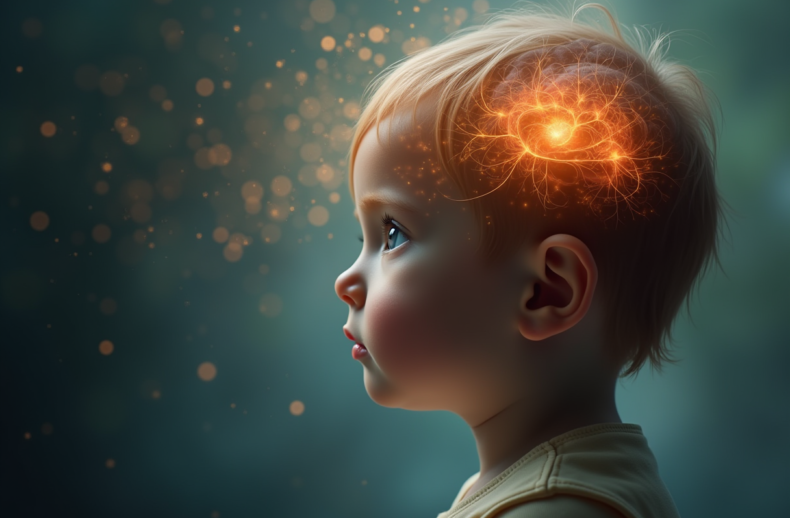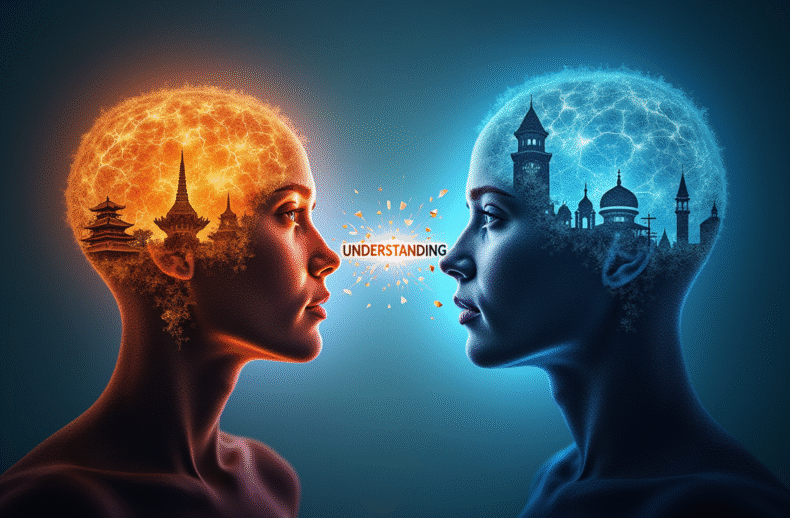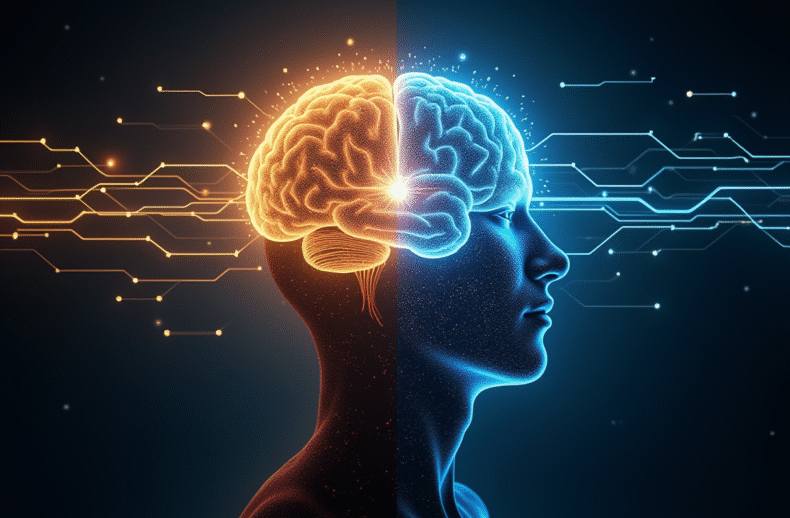
When vision and hearing are absent, intelligence does not disappear—symbols do. DeafBlind cognition reveals how meaning and thought arise before language.

Learning begins with prediction failure. When expected states do not occur, Prediction Feedback (PF) gates learning by shifting the system from exploitation to exploration. What stabilizes are not symbols, but predictive constraints—invariants that reliably reduce uncertainty across interaction. These constraints form functional ontologies: commitments about how the world behaves under action.

Thought is not inner speech. It is the serial traversal of stabilized ontological constraints, enabling internal simulation, comparison, and planning. In DeafBlind cognition, this traversal is tactile–motor; in hearing cognition, language may annotate it. Language does not generate thought.

Language is a structured, shared symbolic system that binds and transmits already-formed ontologies across individuals and generations. It enables society and collective intelligence, but it is not the biological source of meaning.

This ordering—prediction before symbol, ontology before language—has direct implications for AI. Biologically aligned intelligence must begin with embodied prediction and PF-gated ontology formation; language, if added, should function as an interface, not as a substrate.

Tiếp tục đọc

Why do we become the particular persons we are, rather than any of the countless alternatives we might have been? This question precedes morality, psychology, and law. It is asked whenever we judge, diagnose, forgive, or punish. Yet most answers assume that identity is chosen, inherited as character, or consciously learned. This essay argues otherwise. Human identity emerges before intention, self-reflection, or moral reasoning exist. During early development, the brain passively accumulates associations and stabilizes them through Prediction Feedback (PF), a pre-conscious signal of predictive coherence. The resulting noetic horizon silently defines what feels natural, possible, and “like oneself.” Within this framework, crime and so-called perversions are not moral failures or genetic defects but intelligible outcomes of how identity stabilizes under unbalanced PF conditions. We are not the authors of who we are; we are the outcome of what once made our inner world coherent.

Tiếp tục đọc

Emotions are not chemical reactions, neural firings, or conscious feelings. They are inherited semantic patterns that evolved to be expressed and recognized. Each basic emotion is instantiated through two distinct but coupled systems: an expression pattern that organizes the body into a meaningful social signal, and a recognition pattern that detects these signals in others and in oneself through visual, auditory, and interoceptive channels. Emotional feeling does not generate emotion; it emerges later as the perceptual recognition of the body’s own expressed state. By separating expression from recognition and locating emotion in embodied semantic patterns rather than in transmitters or brain regions, this framework explains emotional universality, infant emotional competence, cross-cultural recognition, and the persistent confusion between bodily signals and felt experience.

Tiếp tục đọc

Nations are not held together by shared beliefs or unanimous agreement. They remain stable because citizens develop a shared sense of reality—a common set of expectations about what is real, what consequences will follow actions, and which futures are plausible. This sense of reality operates below ideology and opinion and is reinforced through institutions, rituals, and social consequences. The public return of North Korean soldiers from foreign deployment illustrates how societies actively repair and stabilize these shared expectations, absorbing potentially disruptive experiences into a coherent national order rather than allowing them to fracture it.

Tiếp tục đọc

Human personality does not originate in moral choice or conscious reasoning. Long before the brain can think symbolically, it evaluates. From birth, inherited neural comparators continuously distinguish comfort from discomfort, safety from threat, and coherence from instability. These evaluations regulate early prediction patterns through Predictive Feedback (PF), while emotions function as broadcast signals of the brain’s internal regulatory state—coordinating action internally and communicating condition externally.

During early childhood, repeated emotional and social interactions calibrate these comparators and stabilize specific predictive pathways. This process shapes the developing prefrontal cortex and biases how the individual later restores internal balance. What societies eventually label as “good” or “bad” personality traits are not moral properties encoded in the brain, but observable outcomes of this early regulatory development. Understanding personality in this way shifts the question from judgment to development, and from ethics to neurobiological regulation.

Tiếp tục đọc

Structural neuroimaging consistently reveals small but statistically significant differences in average brain morphology across human populations. These findings are often misinterpreted as evidence of inherent cognitive or behavioral divergence. This essay argues that such inferences are technically invalid. Macro-scale brain measures—such as volume, cortical thickness, and white matter integrity—operate within a functional vacuum: they lack a reliable causal mapping to cognition or behavior. Cognitive capacity arises not from physical bulk, but from the brain’s semantic–associative architecture and its regulation by internal Prediction Feedback. Observed structural differences are therefore best understood as biomarkers of environmental and socioeconomic disparity, not determinants of intelligence or behavioral potential.

Tiếp tục đọc

Love is not an emotion in the classical or neuroscientific sense, nor is it a hormone-driven state or a learned social script. Within a Predictive Feedback (PF)–based model of cognition, love emerges as a resonance phenomenon: a self-stabilizing loop between sustained positive PF and its rendering in perceptual awareness. Emotions, in this framework, are blind, non-directed broadcasts of the organism’s current mental state, implemented through inherited physiological patterns and recognized by equally inherited perceptual comparators. Feelings arise only when awareness interprets these broadcasts using learned entities and contextual associations. Love, therefore, is neither broadcast nor comparator output, but a persistent PF-positive resonance that awareness repeatedly reifies as a coherent feeling. When prediction confirmation collapses, love dissolves—not because an emotion has ended, but because the PF resonance that sustained the feeling has broken.

Tiếp tục đọc

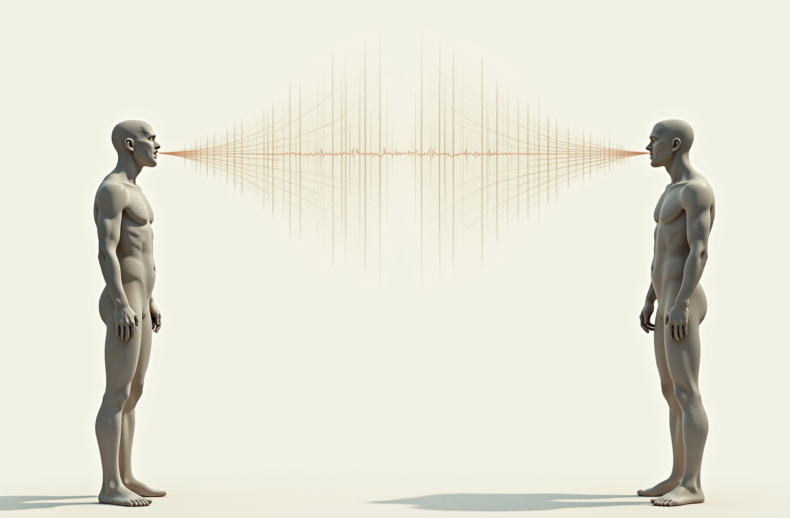
The brain does not seek truth—it seeks resonance.
We understand only what matches our internal architecture of associations.
When two minds resonate within different architectures, they believe they understand while actually confirming only themselves.
This is the deepest illusion of culture: that shared language equals shared meaning.
True understanding begins not with empathy, but with neural alignment—the slow reconstruction of matching associations through lived experience.

Tiếp tục đọc

Prevailing theories in neuroscience explain learning and motivation through reward, drive reduction, or utility maximization. This article challenges that framework by introducing the Demand for Recognition (DfR) as the true root mechanism. DfR is an inherited limbic loop that continuously evaluates feedback in binary terms—comfortable or uncomfortable—modulates plasticity, and sustains self-learning. Unlike AI, which requires externally imposed recognition surrogates, the human brain self-learns because DfR ensures constant adjustment to recognition signals. Reframing recognition as fundamental and reward as secondary unifies perspectives from neuroscience, psychology, AI, and evolutionary theory, setting the stage for broad interdisciplinary debate.
I claim that no self-learning system can exist without recognition. Brains achieve adaptation by minimizing recognition deficits. AI, by contrast, adapts only through external recognition surrogates imposed by developers. Reframing DfR as the fundamental driver of cognition challenges current reward-centric models.

Tiếp tục đọc

While classical entropy describes the universe’s descent into disorder, Evolutionary Entropy reveals its hidden counter-force: the selective collapse of chaos into form. In open systems, where energy flows and selection occurs, only configurations that persist and cohere remain. Evolutionary Entropy is the scientific backbone of Eidoism — the law by which Form survives.

Tiếp tục đọc

lên đầu trang
vi